

Skip to content

Supply chain & textile solutions · Design · 3D · Production

From raw fibre to your finished garment

Kreavtiv Studio is a B2B apparel and textile partner. Fashion design, CLO 3D, tech packs, fabric, sampling, manufacturing, QC and export — managed under one roof.

Scroll to enter the lab
Knit · Woven · Denim · WorkwearCLO 3D · Tech packs · SamplingFinal AQL inspection · Worldwide delivery

The supply chain journey · 9 stages

Skip the journey

Stage 01 / 09 Material track

Every garment starts as fibre

Raw material

Cotton is harvested, ginned to separate lint from seed, pressed into bales, then opened and cleaned at the mill. Fibre length, strength and cleanliness shape every decision that follows, from yarn count to the handfeel of the finished T-shirt.

Stage details
Fibre
Cotton (other fibres and blends on request)
Staple length
28–32 mm (long staple for ring-spun jersey)
Certified sources
Organic, BCI and recycled cotton on request
  • FIG. 01 Fibre type

    Cotton is the reference fibre. Organic cotton, cotton-poly, cotton-elastane and recycled blends are available.

  • FIG. 02 Staple length

    Longer staple fibres spin into finer, stronger, smoother yarns. We spec 28–32 mm for premium jersey.

  • FIG. 03 Sustainability claims

    Organic, BCI and recycled cotton options available on request, with supplier certificates.

Coordinated About this stage
Stage 02 / 09 Material track

Fibre becomes yarn, yarn becomes jersey

Yarn and fabric

Fibres are carded, drawn and spun into yarn; yarn count and twist set strength and feel. Circular knitting machines then loop the yarn into a tube of single-jersey fabric, where gauge, loop length and finishing determine GSM and handfeel.

Stage details
Yarn count
Ne 20/1 – 40/1
Spinning
Combed ring-spun or open-end
Structure
Single jersey
GSM range
140–400 GSM
  • FIG. 04 Yarn count

    Finer counts give lighter, smoother fabric. Ne 20/1 to 40/1 covers most T-shirt weights.

  • FIG. 05 Spinning method

    Ring-spun yarn is smoother and stronger; open-end is more economical. Combed ring-spun is our default for premium jersey.

  • FIG. 06 Knit structure

    Single jersey: one set of needles, smooth face, looped back — the classic T-shirt fabric.

  • FIG. 07 Machine gauge

    Needles per inch on the knitting machine; higher gauge, finer fabric. Jersey is typically 24–28 gauge.

  • FIG. 08 GSM

    Grams per square metre — fabric weight. Range: 140–400 GSM.

Stage 03 / 09 Material track

Colour is engineered, then proven

Dyeing and fabric finishing

Greige fabric is scoured and bleached, then dyed — reactive dyes are common for cotton — before washing off, softening, drying and compacting to control shrinkage. Lab dips and shade approval come first; tests confirm shrinkage, colour fastness and GSM.

Stage details
Dye type
Reactive (cotton), pigment and garment dye
Shade approval
Lab dip
Tests
Shrinkage, colour fastness, GSM
Finishes
Enzyme, silicone softener, compacting, brushing
  • FIG. 09 Pre-treatment

    Scouring and bleaching remove natural waxes and impurities so dye takes evenly.

  • FIG. 10 Dye type

    Reactive dyes bond chemically with cotton for good wash fastness. Pigment and garment dyes are used for washed looks.

  • FIG. 11 Shade approval

    A lab dip is a small dyed sample approved against the colour standard before bulk.

  • FIG. 12 Finishing

    Softening, drying and compacting set handfeel and control shrinkage.

  • FIG. 13 Tests

    Shrinkage (≤5%), colour fastness to washing and rubbing (grade 4), and GSM (±5%).

Stage 04 / 09 Design track

The garment exists digitally first

Design, pattern and CLO 3D

A tech pack drives the CAD pattern pieces — front, back, sleeves, neck rib — graded across sizes. CLO 3D simulates fabric, fit and drape on an avatar so changes are made before physical sampling, and approved changes flow back into the tech pack.

Stage details
Pattern pieces
Front, back, sleeves ×2, neck rib
Size range
XS–3XL (custom grading available)
Software
CLO 3D, CAD
Output
Tech pack, graded pattern, 3D sample
  • FIG. 14 Chest

    Point of measure: 1 cm below armhole, side to side. Base size M: 54 cm ±1.

  • FIG. 15 Shoulder

    Shoulder seam point to shoulder seam point. Base size M: 48 cm ±1.

  • FIG. 16 Sleeve

    Sleeve length from shoulder point. Base size M: 22 cm ±1.

  • FIG. 17 Hem

    Hem width and finish (coverstitch). Base size M: 52 cm, 2.5 cm hem.

  • FIG. 18 Neck

    Neck width and rib height. Base size M: 18 cm wide, 2 cm rib.

Stage 05 / 09 Tracks converged

Precision before a single stitch

Cutting

Here the material and design tracks converge. Pattern pieces are nested in a marker to reduce waste, fabric is spread in layers, and pieces are cut with automatic or straight-knife cutters — then numbered and bundled to keep size and shade consistent.

Stage details
Marker efficiency
Typically 80–88%
Lay height
Up to 80 plies
Cutting
Automatic CAD cutter or straight knife
  • FIG. 19 Marker efficiency

    Share of fabric used by pattern pieces — typically 80–88% for T-shirts.

  • FIG. 20 Lay height

    Number of plies cut at once — up to 80 plies on the automatic cutter.

  • FIG. 21 Cut accuracy

    Cut to within ±2 mm of the pattern line, checked on top and bottom plies.

  • FIG. 22 Bundle coding

    Pieces are numbered by ply so size and shade stay matched in sewing.

Stage 06 / 09 Tracks converged

Construction, seam by seam

Sewing and assembly

Shoulders are joined with an overlock, the neck rib is attached and taped, sleeves are set and side seams closed. Sleeve and body hems are finished with a coverstitch and labels attached, while inline checks catch defects early.

Stage details
Seams
Overlock
Hems
Coverstitch
Labels
Woven main label, printed care and size labels
Inline QC
Inline checks on every line, end-of-line inspection
  • FIG. 23 Neck rib

    Rib knit collar attached to the neckline and stretched for recovery.

  • FIG. 24 Shoulder tape

    Tape across the back neck and shoulders stabilises the seam.

  • FIG. 25 Sleeve set

    Sleeves joined to the body at the armhole.

  • FIG. 26 Side seam

    Overlocked from hem to sleeve end.

  • FIG. 27 Hem | Coverstitch

    Twin-needle coverstitch finishes body and sleeve hems with stretch.

  • FIG. 28 Main label

    Brand label at the back neck. Placement consistent with the Tech Pack Builder.

Stage 07 / 09 Tracks converged

Measured against the tech pack

Garment finishing and quality

Threads are trimmed and spots cleaned; some styles are garment-washed or softened, then pressed. A measurement audit checks every point of measure against the tech pack, and final inspection follows an agreed sampling plan.

Stage details
Washes
Enzyme, garment dye, acid, stone, bleach, softener
Measurement audit
Against tech pack tolerances
Sampling plan (AQL)
Final AQL inspection — AQL 2.5 / 4.0
Detection
Needle detection on request
  • FIG. 29 Garment wash

    Enzyme, silicone softener or garment-dye wash for handfeel, where the style needs it.

  • FIG. 30 Pressing

    Steam pressing sets shape before folding.

  • FIG. 31 Measurement audit

    Points of measure checked against the tech pack.

  • FIG. 32 Final inspection

    AQL 2.5 major / 4.0 minor, general inspection level II.

Stage 08 / 09 Tracks converged

The sum of every decision

Final garment

The finished T-shirt is the result of every earlier decision: fibre, fabric, shade, pattern, construction and finish. Compare the digital CLO render with the physical product, and inspect the details that define quality.

Stage details
Fabric
Single jersey, 180–240 GSM
Fit
Regular, oversized and boxy
Finish
Enzyme or silicone softener wash
  • FIG. 33 Material detail

    Combed ring-spun single jersey, 220 GSM, 11–12 stitches per inch.

  • FIG. 34 Drape

    How the fabric hangs, set by fibre, yarn, knit and finish.

  • FIG. 35 Fit notes

    Fit approved in CLO 3D and on the physical sample — regular, oversized or boxy.

Stage 09 / 09 Tracks converged

Ready for your brand

Packaging and distribution

Garments are folded, polybagged, labelled or hang-tagged, then packed into mailers, boxes or cartons. Cartons are palletised and shipped by sea, air or courier with the documents your destination requires. The last label is yours.

Stage details
Packing
Fold, polybag, hangtag, carton
Custom packaging
Optional
Export
Documentation, compliance, freight
Delivery
Worldwide
  • FIG. 36 Fold and polybag

    Folded to specification and bagged for protection.

  • FIG. 37 Labels and hangtags

    Brand, size, care and price labels per your specification.

  • FIG. 38 Mailer or box

    Neutral or custom-printed mailers and boxes.

  • FIG. 39 Carton and pallet

    Cartons palletised for freight to the UK, EU, US, Middle East and worldwide.

Production model

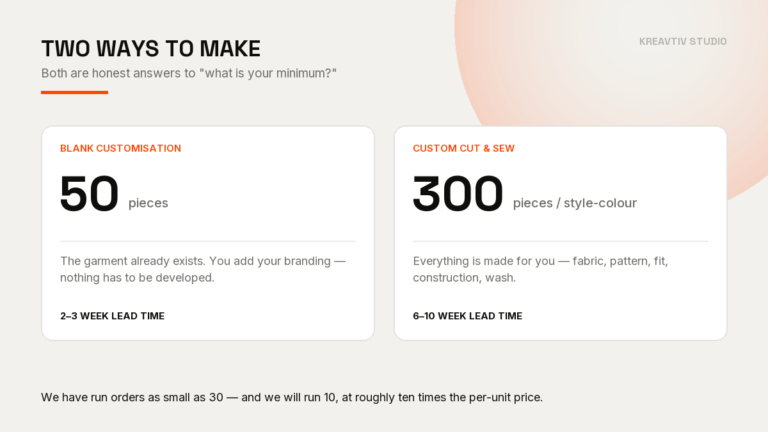
Two routes to production

Path A

Low-MOQ blank customisation

Premium blanks customised with DTG, screen print, embroidery, relabelling and custom packaging. Example MOQ: 50 units per design

Path B

Full custom cut and sew

Custom patterns, fabric, dyeing, wash, fade, distressing, finishing and construction. Example MOQ: 300 units per style / colour

Blank customisation compared with custom cut and sew
CapabilityBlank customisationCustom cut and sew
MOQ Blank customisation: 50 units per design Custom cut and sew: 300 units per style / colour
Lead time Blank customisation: 2-3 weeks after artwork approval Custom cut and sew: 6-10 weeks after pre-production approval
Fabric Blank customisation: Pre-made garment Custom cut and sew: Developed or sourced to spec
Fit Blank customisation: Blank's existing fit Custom cut and sew: Custom pattern and grading
Pattern Blank customisation: Not applicable Custom cut and sew: Full CAD pattern and CLO 3D
Dyeing Blank customisation: Not applicable Custom cut and sew: Custom dye

All MOQs, lead times and route details are indicative and confirmed after technical review.

Ready to make it real?