
Search “low MOQ clothing manufacturer” and you will get a long list of factories all claiming to welcome small orders. Almost none of them publish what their minimum actually is. That tells you something, and it is the thing this article is about.
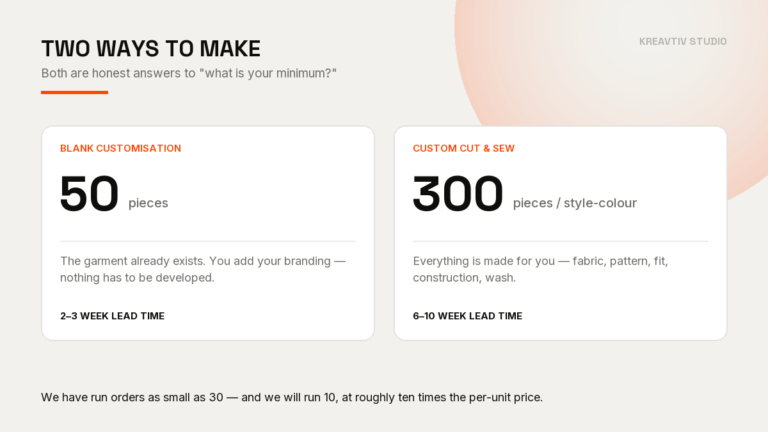
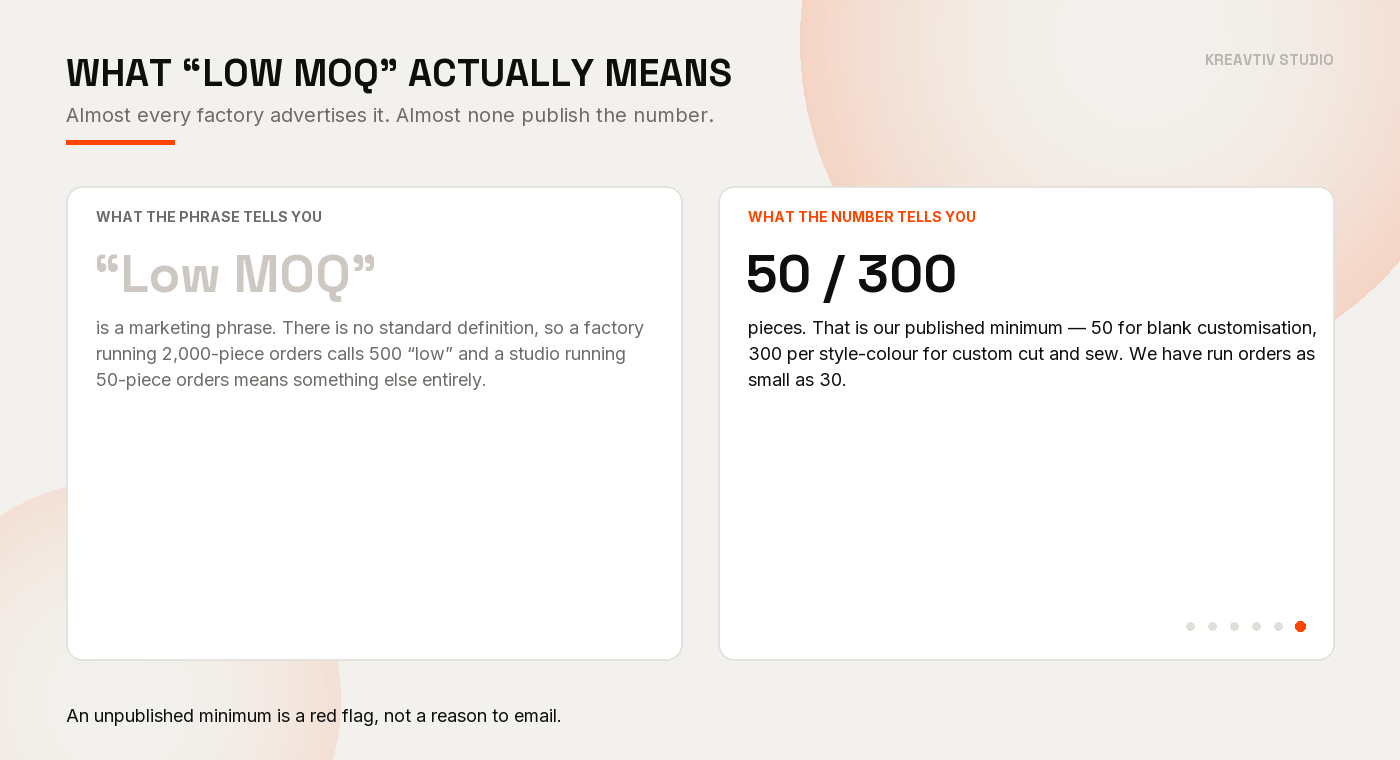
Our minimums are 50 pieces for blank customisation and 300 pieces per style-colour for custom cut and sew. We have run orders as small as 30. If you want to skip straight to how we work, that is on our clothing manufacturing page. The rest of this article is about how to judge every other supplier you are considering, including the ones that will waste your time.
Short answer
A low MOQ manufacturer is one whose published minimum is genuinely achievable for your order. Ours are 50 pieces for blank customisation and 300 pieces per style-colour for custom cut and sew, and the smallest order we have actually run is 30 pieces. Judge any supplier by four numbers: the minimum and what it applies to, the per-unit price at that minimum, the lead time at that minimum, and whether the minimum drops on reorder.
| What you want to know | Blank customisation | Custom cut and sew |
|---|---|---|
| Minimum order | 50 pieces | 300 pieces per style-colour |
| Lead time | 2-3 weeks | 6-10 weeks incl. sampling |
| Best for | Validating a product quickly at lower cost | Unique fit, fabric or construction |
| Pattern exclusivity | Stock garment, shared | Pattern developed for you only |
Why “low MOQ” is a marketing phrase, not a specification
There is no standard definition of low MOQ. A factory that runs 2,000-piece orders will call 500 “low.” A studio that runs 50-piece orders means something completely different by it.
So when you see “low MOQ” on a website, you have learned nothing yet. You have found a phrase, not a number. The number is the only part that matters to your budget and your cash flow.
What makes this worse is that the phrase is cheap to publish and expensive to honour. A factory can write “low MOQ” on its homepage, take your enquiry, and then quote you a minimum of 800 when you get on the call. You have lost a week.
The single most useful thing you can do when shortlisting manufacturers is to treat an unpublished minimum as a red flag rather than a reason to email. A factory confident in its minimum publishes it.
The four numbers that actually define a “low MOQ” factory
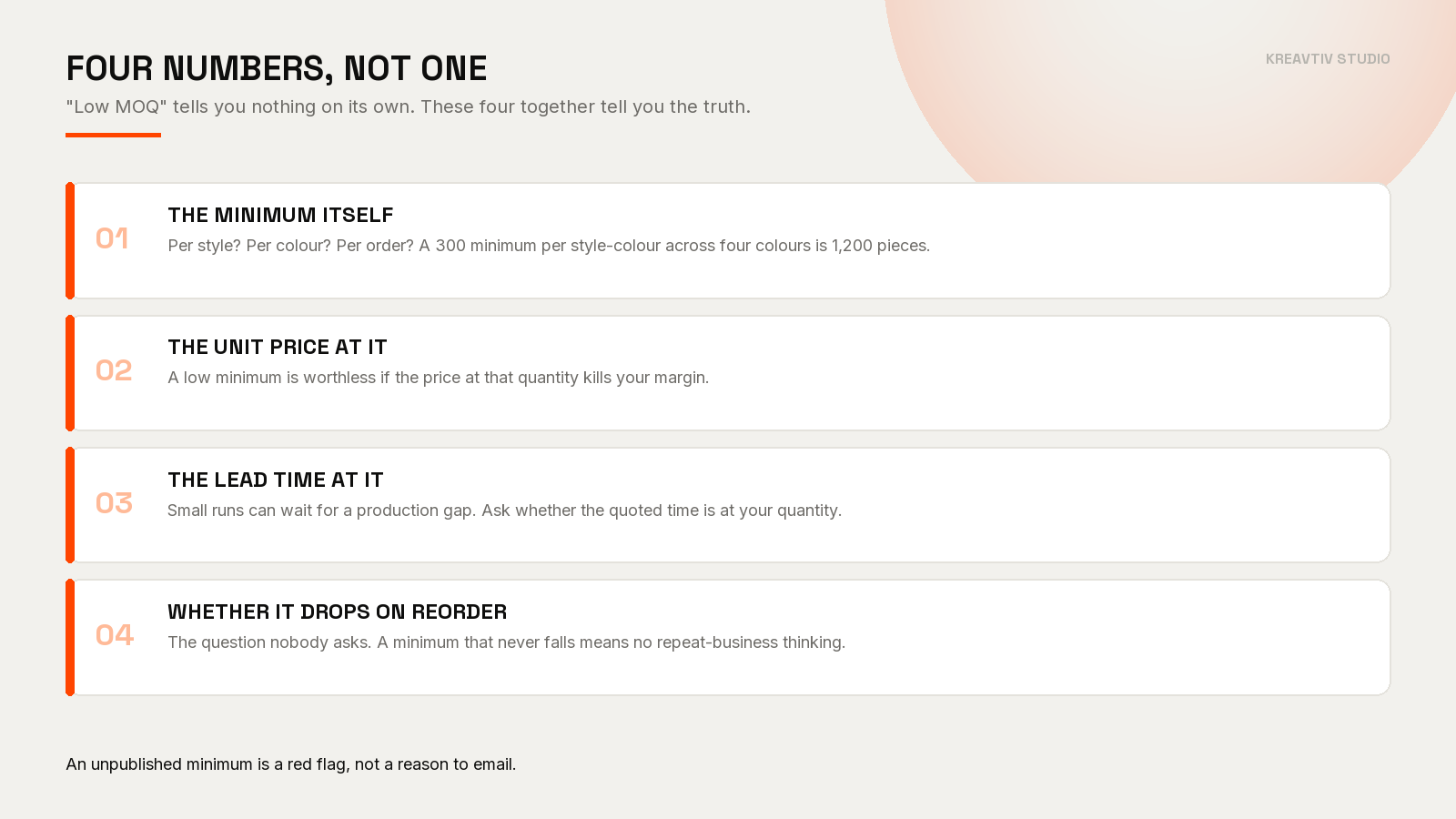
Minimum order quantity on its own will mislead you. Four numbers together give you the real picture.
1. The minimum itself, and what it applies to. Per style? Per colour? Per order? A 300-piece minimum per style-colour on a four-colour range is 1,200 pieces. A 300-piece minimum on the total order is 300. Those are not the same offer, and the difference is rarely stated clearly.
2. The per-unit price at that minimum. This is where “low MOQ” factories separate. A minimum of 50 means nothing if the unit price at 50 is so high that you cannot sell the product profitably. Ask for the unit price at your actual quantity, not at an imaginary bulk quantity.
3. The lead time at that minimum. Small runs sometimes wait for a gap in the production calendar, which pushes the lead time out considerably. Ask whether the lead time quoted is the lead time at your quantity. Our published lead times are 2-3 weeks for blank customisation and 6-10 weeks for cut and sew.
4. Whether the minimum drops on reorder. This is the question almost nobody asks and it has the biggest long-term effect. Once a pattern, a dye lot and a setup exist, a reorder is a much smaller job. A factory that keeps the same minimum forever is one that has not thought about repeat business.
Red flags when you are shortlisting
You will speak to a lot of suppliers. These are the signals worth acting on.
- The minimum is not published anywhere. Not on the site, not in a FAQ, not in a pricing guide. You have to ask to find out, which means they are choosing who to tell.
- The answer changes between the first email and the quote. A minimum that grows is a minimum that was never real. This is the most common experience small brands report.
- They will not give a unit price before you commit. Some factories want your order value first. You cannot plan a business without a unit price, and a supplier who will not give you one is asking you to buy blind.
- They quote a lead time and then extend it. Ask what happens if the date slips. A supplier with a real answer has thought about it.
- They accept every order instantly and enthusiastically. This sounds like good service. It usually means the order will be subcontracted to whoever has capacity, and you will lose control of quality.
- They say yes to something that makes no sense. This is the one worth explaining, because it is the most common lie in the trade.
- No named person. If your only contact is a generic sales address, you cannot hold anyone accountable when something goes wrong.
The “yes” that should worry you
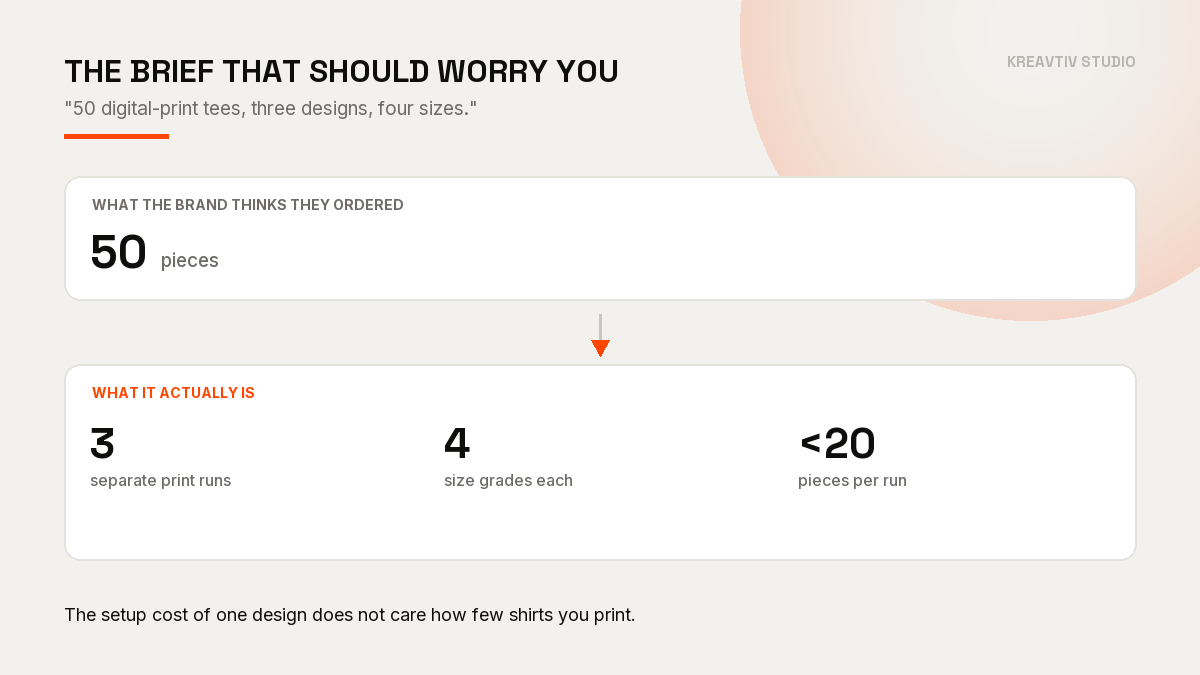
Picture a real enquiry we get. A brand wants 50 digital-print t-shirts. Three different designs. And the 50 pieces have to be split across four sizes.
Read that carefully. It is not a 50-piece order. It is three separate print runs of under 20 pieces each, spread across four size grades, on a process where the setup cost of a single design does not care how few shirts you print.
We say no to that. Not because we cannot physically produce it, but because the truthful unit price at that specification is not a price anyone would accept once they saw it. Any factory that says “yes, no problem, 50 pieces” to that brief is going to either disappear, cut every corner, or charge you triple after you have committed.
An honest manufacturer has a line, and you should ask what it is. If a supplier says yes to everything, they are not being accommodating. They are avoiding a conversation they know will cost them the order.
What to ask, in the order that saves you time
Ask these in sequence. Each answer tells you whether to continue.
- “What is your minimum, and is it per style, per colour, or per order?” – establishes the real number.
- “What is the unit price at 50 pieces, and at 300?” – reveals whether their “low MOQ” is workable or just affordable to advertise.
- “Is the lead time at 50 the same as at 1,000?” – surfaces the gap-filling problem early.
- “Does the minimum come down on a reorder?” – the best single predictor of whether they want a relationship or a transaction.
- “Is there anything you would turn down?” – the question almost nobody asks, and the one that reveals the most. A supplier who cannot name a limit has not thought about your order.
- “Who will I actually deal with day to day?” – gets you a name before you send money.
If a supplier answers all six directly, you have found someone worth taking seriously. If they deflect on two or more, you have saved yourself a month.
Before you ask a supplier anything, know what you want
This is the part that sits upstream of everything else, and it is where most small brands lose weeks.
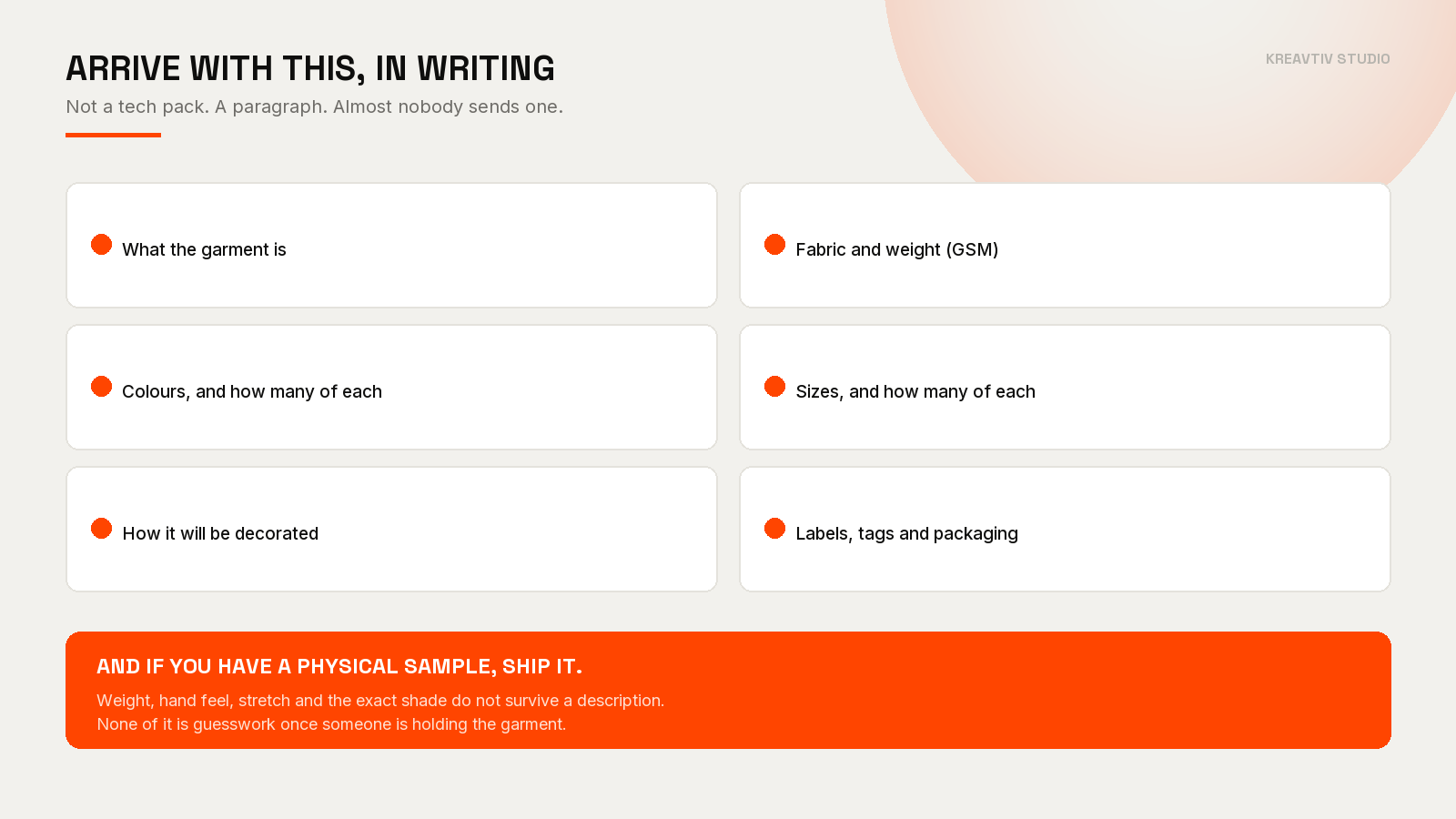
Before you contact anyone, you should be able to state, in writing: what the garment is, what it is made from, what it should weigh, what colours and how many, what sizes and how many of each, and how it will be decorated. That is not a tech pack. It is a paragraph. But almost nobody arrives with it.
What happens instead is a vague brief, a factory guessing at what you meant, a sample that is not what you wanted, and three weeks gone. The factory gets blamed. Usually the brief was the problem.
If you already have a physical sample, ship it. This is the single highest-leverage thing you can do, and it is the thing brands resist most because of the postage. A sample in a factory’s hands removes guesswork that no number of emails can remove. Weight, hand feel, stretch, the exact shade of the colourway, how the collar sits – none of that survives a description. All of it is obvious the moment someone holds the garment.
Postage is trivial next to the cost of 300 pieces made wrong, and it has the useful side effect of making your enquiry serious. Factories prioritise the brand that sent something over the brand that sent a message asking “how much for hoodies?”
The difference between a low minimum and a good fit
Here is the part most shortlisting guides skip. A low minimum that does not match your product is worse than a higher minimum that does.
If your product is a standard tee or hoodie with your branding on it, you want a supplier set up for blank customisation. Development is minimal, which is exactly why the minimum can sit at 50. Our blank customisation service exists for this, and it is where most first collections should start.
If your product needs its own fit, its own fabric, its own wash, you are in cut and sew territory. The minimum of 300 per style-colour is not a barrier anyone invented to keep you out. It is the point at which the development work starts to make sense. You can read how the two routes differ on our production page.
A supplier offering a 30-piece minimum on a fully developed, custom-dyed product is either losing money on you or has not understood what you asked for. Both outcomes are bad for you.
What to do before you pay anything
Whichever supplier you choose, three things should happen before a deposit leaves your account.
You see a sample first. Not a photo of a similar garment. A sample of your product. This is the single largest quality risk you can remove, and the cost of a sample is trivial next to the cost of 300 wrong garments.
You have the specification in writing. Fabric, weight, colour, construction, trims, labelling, packaging. Written down, not agreed verbally. Every dispute that reaches a factory floor is a dispute about something that was never written.
You know what happens if it goes wrong. What is the rework policy? Who pays for a rejected batch? Ask before you need to know.
None of this is complicated. It is simply the difference between a manufacturer who runs small orders well and one who says they do.
Where this leaves you
A low minimum is only useful if the unit price, the lead time and the reorder terms are also workable. Judge the whole offer, not the headline number. And arrive with a clear brief and a sample if you have one – it will do more for your result than any amount of comparing suppliers.
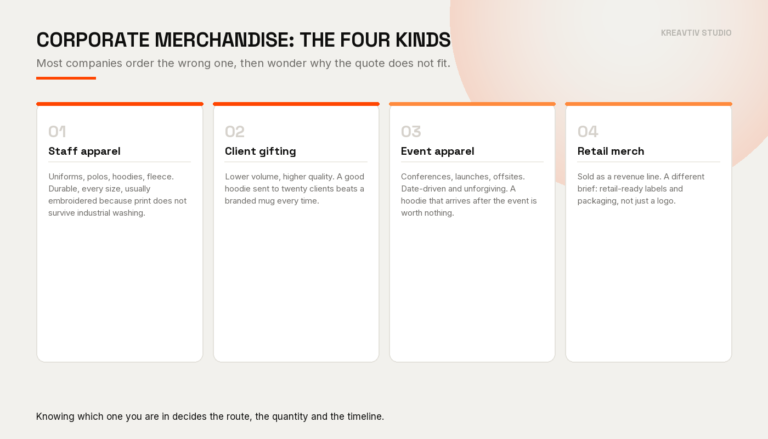
Our minimums are 50 pieces for blank customisation and 300 per style-colour for custom cut and sew, and we have run orders as small as 30. We publish them because we would rather you knew now than found out on a call. We will tell you honestly when a brief does not make sense, and we will tell you what would make it work instead. The estimator will give you a starting figure, or send us what you are trying to make and we will tell you which route fits – including if neither does.