
Most factories will not tell you their minimum order quantity until you have already spent an hour on a call. Some never tell you at all – they just stop replying once they hear your numbers.
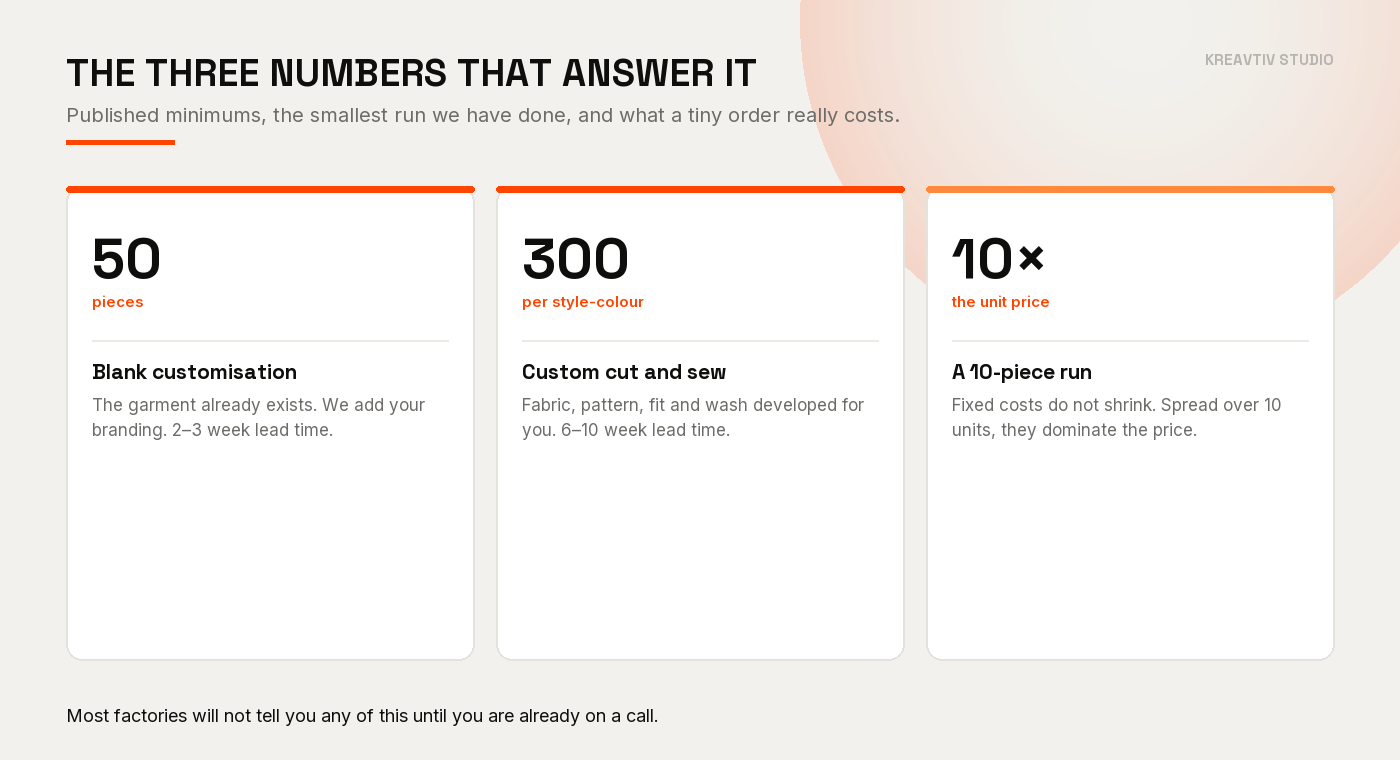
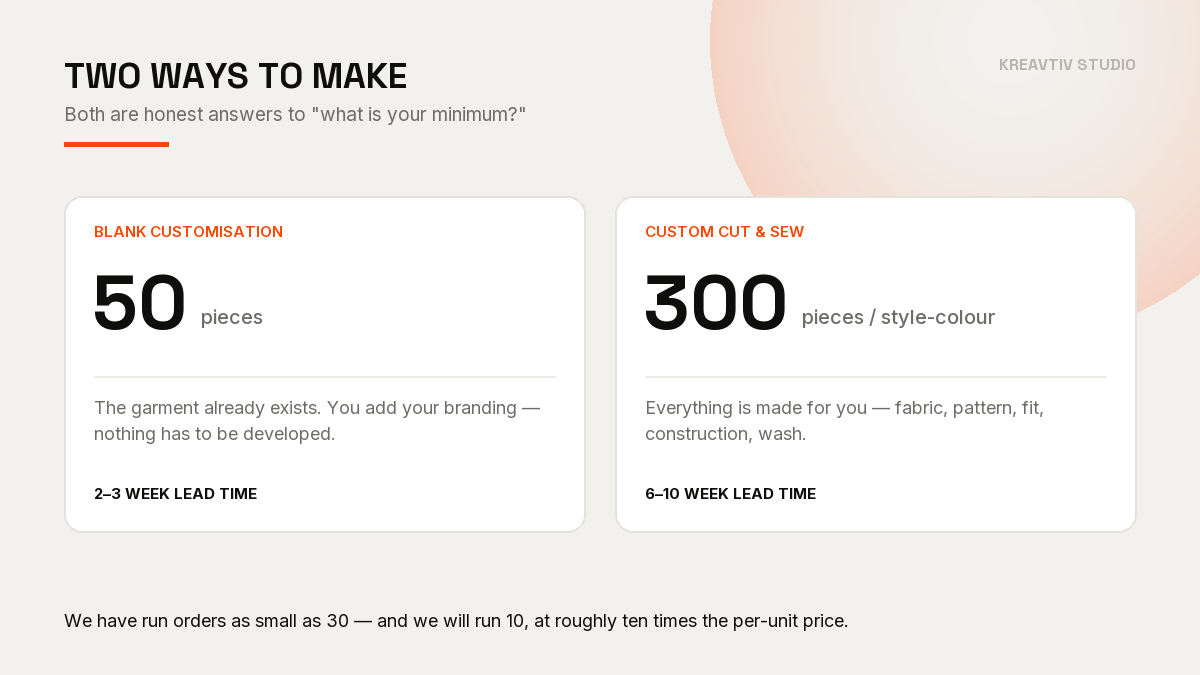
So let us answer it directly. Our published minimum is 50 pieces for blank customisation, and 300 pieces per style-colour for fully custom cut and sew. The smallest order we have actually run was 30 pieces.
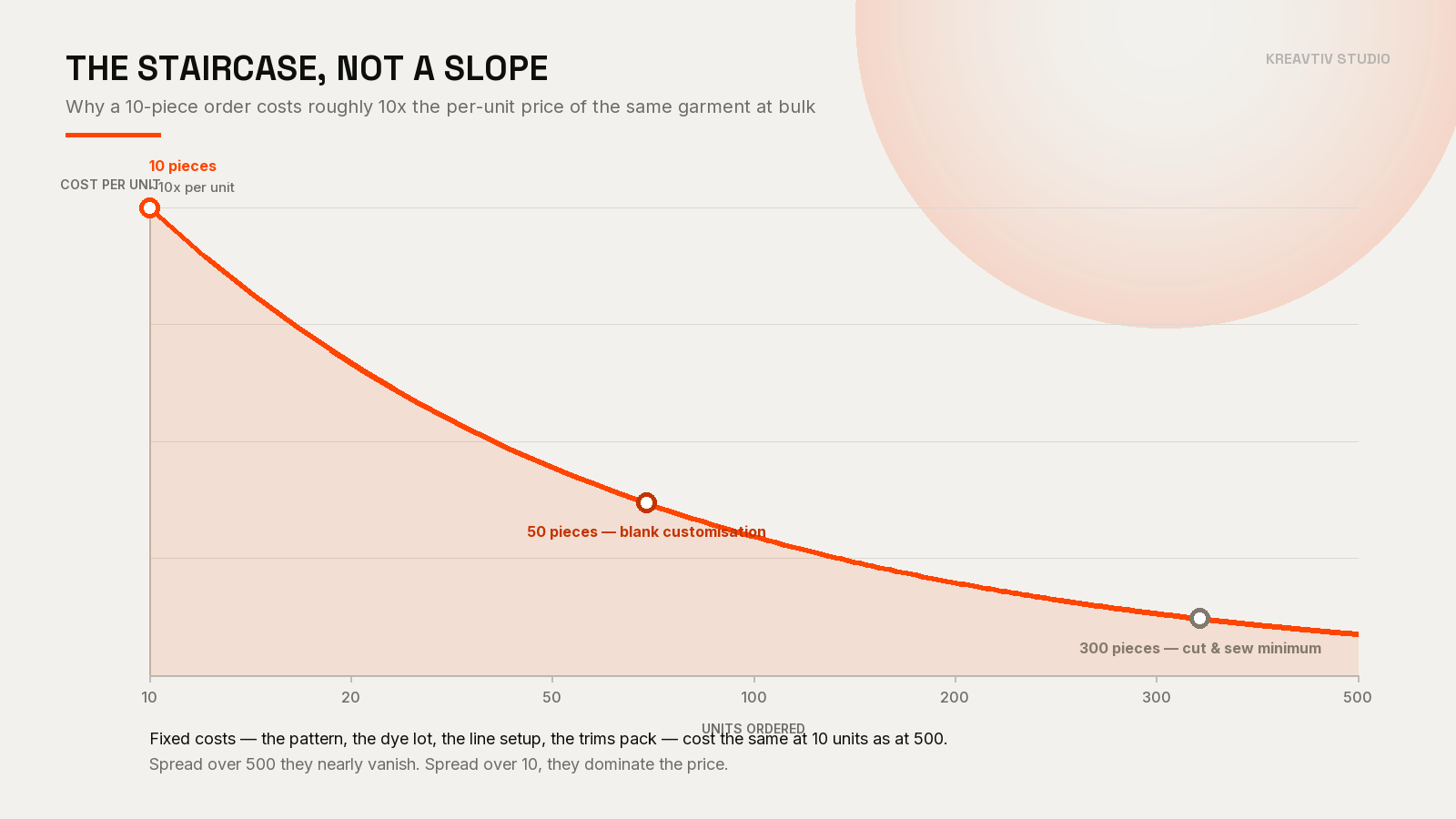
We will also run 10 if you genuinely need 10. But you should know what that costs before you ask, because the honest answer is that those 10 pieces will come in at roughly ten times the per-unit price of the same garment at bulk. That is not a penalty we are adding. It is what the work actually costs when it is spread across ten units instead of five hundred.
But the more useful answer is why minimums exist at all, because once you understand the arithmetic behind them, you can stop wasting time on factories that were never going to say yes – and stop assuming the problem is you.
The short answer, by manufacturing type
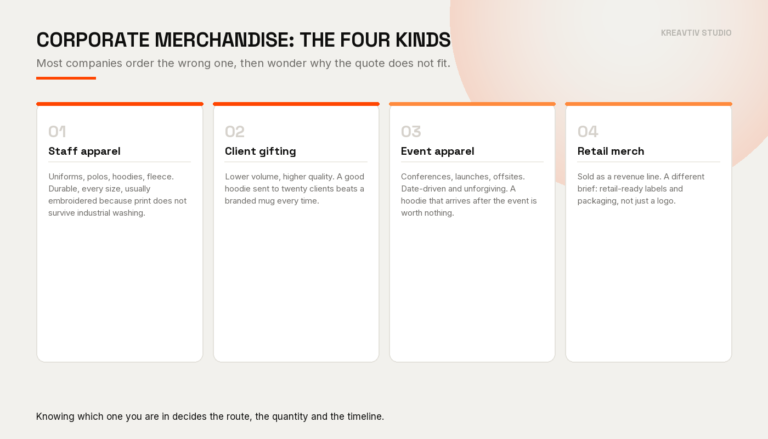
Minimum order quantity is not a single number. It depends on how much of the garment has to be built specifically for your order.
- Blank customisation: 50 pieces. The garment already exists, so nothing has to be developed. You are adding your branding to something a factory already makes.
- Custom cut and sew: 300 pieces per style-colour. Everything is made for you – fabric, pattern, fit, construction, wash. That development has to be paid for somehow.
- Screen printing: often has its own minimum per design, separate from the garment minimum, because screens have to be burned.
- Custom fabric development: frequently the highest minimum in the chain – mills dye in batches, and those batches are large.
If you only take one thing from this article: the minimum you hit is usually set by the fabric mill or the printer, not by the sewing floor. That is why the number moves depending on what you are making.
Why minimums exist – the honest arithmetic
Founders often assume minimums are a deliberate barrier, or that factories are being lazy. Neither is true. Every minimum traces back to a fixed cost that does not shrink just because your order is small.
Walk through what a 10-piece order actually sets in motion.
The pattern still has to be made. A pattern maker drafts every piece – front, back, sleeves, rib, collar, pockets – and grades it across your size range. That work takes the same hours whether you cut 10 units or 1,000. Spread across 10 pieces, the pattern alone can add more to your unit cost than the fabric and sewing put together.
The fabric has to be dyed in a batch. Mills do not dye 12 metres. They dye hundreds. On a small order you either take stock fabric in a colour that already exists, or you pay for an entire dye lot and end up sitting on far more fabric than you need.
The line has to be set up. Before a single garment is sewn, machines, threads, attachments and a sample station all get set for your item. That is hours of work, and it costs exactly the same whether the run is 10 pieces or 1,000.
Trims come in packs, not pieces. Zips, buttons, drawcords, labels and tags are ordered in quantities far above what a 10-piece run needs. You buy the pack.
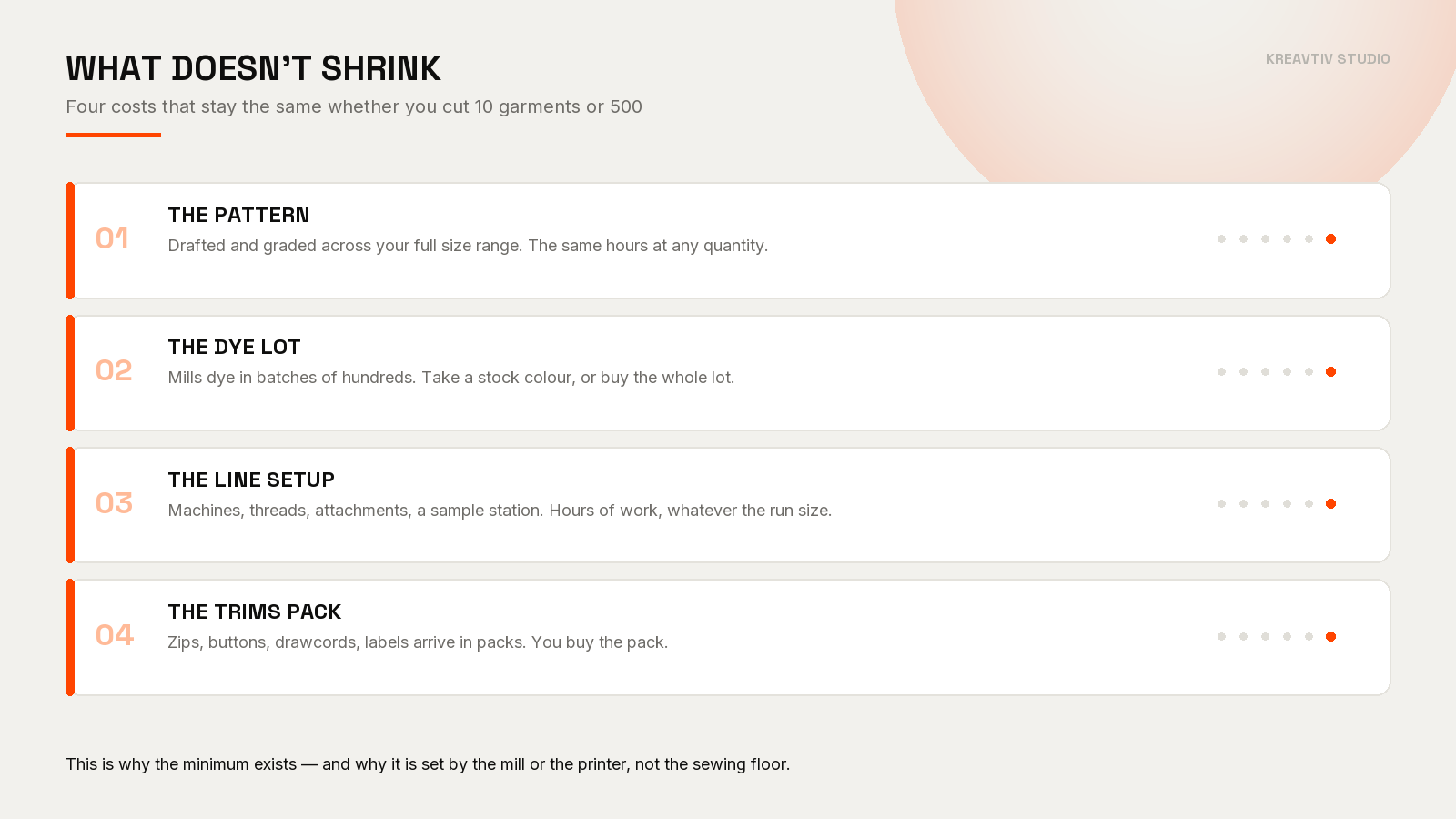
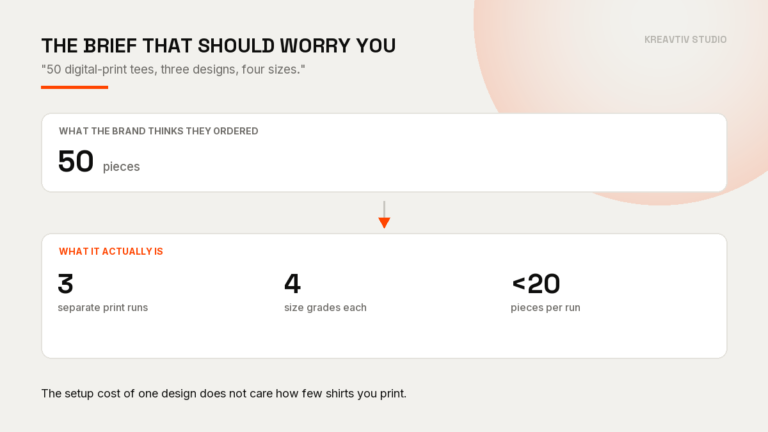
This is the part that catches people out: a 10-piece run can cost around ten times more per unit than the same garment at bulk. Not a punishment for ordering small. The pattern, the dye batch and the line setup all cost the same whether you cut 10 units or 500. Spread over 500 they nearly vanish. Spread over 10 they dominate the price.
There is one more thing, and it is less comfortable to say out loud. A very small order is not profitable, and pricing it down to win the work is how a factory ends up closing. Any factory quoting you the same unit price for 10 pieces as for 500 is either making a mistake or planning to recover it somewhere you will not notice.
The misunderstanding that costs founders the most
The single most common assumption we run into is this: that you can order any quantity you like and still get the best price.
It sounds reasonable. In most of commerce it is true – buy more, pay less per unit, but there is no cliff edge. Small orders just cost a little more.
Apparel does not work that way. Quantity and price are not joined by a gentle slope. It is closer to a staircase, and the steps are set by the fixed costs underneath: the pattern, the dye lot, the line setup, the trims pack.
So a founder orders 40 pieces expecting a modest markup over the 300-piece price, and is genuinely shocked when the quote comes back at several times that. They assume they are being taken advantage of. They are not – they have simply asked for the most expensive way there is to make a garment, and nobody explained the arithmetic first.
Knowing this changes how you plan. If your budget is fixed and your quantity is flexible, you will get far more garment for your money at 100 pieces than at 20. If your quantity is fixed and your budget is flexible, expect the per-unit price to reflect that.
What to do if you need fewer than 50 pieces
We will run a 30-piece order. We will even run 10. But before you ask, understand what you are buying – and consider whether one of these four routes gets you a better outcome for the same money.
Use blank customisation. If your garment can be a stock blank – a standard tee, hoodie or sweatshirt – you skip pattern development and fabric dyeing entirely, which is why the minimum can drop to 50. This is the route most small brands should start on, and it is what our blank customisation service exists for.
Run a sample-only order first. You do not need 10 finished units to test an idea. You need one good sample. That is a much smaller job, and it tells you whether the product works before you commit to scale.
Accept stock fabric. If you choose a fabric and colour the factory already holds, you bypass mill minimums. You give up exclusivity on the colour and you gain the ability to order less. For a first collection, that is usually the right trade.
Look for a manufacturer built around small runs. Some are. The tell is whether their minimum is published on their website. A factory that hides its MOQ is usually one that does not want small orders and is avoiding the conversation.
Questions to ask before you commit
Minimums are not the only number that changes when your order is small. Ask these before you pay anything.
- Is the minimum per style, per colour, or per order? A 300-piece minimum per style-colour is very different from 300 pieces total. This single question changes the cost of a four-colour range by four times.
- Does the minimum include the fabric? Some factories quote a garment minimum assuming stock fabric, then the real minimum rises once you want a custom colour.
- Is printing or embroidery counted separately? Decoration often carries its own minimum per design, independent of the garment.
- What is the sample cost, and is it credited against bulk? Sample costs range widely, and some factories deduct them from your production order.
- What happens if I reorder? A reorder should be cheaper, because the pattern and setup already exist. Ask whether your minimum drops.
Our full clothing manufacturing page explains how we handle both routes, and the estimator will give you a starting number based on your actual product.
The mistake most founders make
They treat the minimum as the first obstacle to overcome, and they try to negotiate it down before they have specified the garment.
That is backwards. A factory cannot give you an accurate minimum before it knows what you are making. A basic cotton tee and a washed, garment-dyed, multi-panel hoodie have completely different minimums, because one has almost no development and the other has a great deal.
So the order is: specify the garment first, then discuss the minimum. Founders who arrive with a clear specification – even a simple one – get faster, more accurate answers than those who open with “what is your MOQ?” and nothing else.
If you do not have a specification yet, that is normal and it is not a problem. It just means the first conversation is about the product rather than the number.
Where this leaves you
If you need 30 to 300 pieces, you are in a gap that a lot of factories do not want to serve. That gap is real, it is large, and it is mostly filled by factories that either will not say their minimum or will not honour it once you commit.
We have run orders as small as 30, and we will run 10 if that is genuinely what you need – we will simply tell you the per-unit price honestly first, so the number does not arrive as a shock. Our published minimums are 50 pieces for blank customisation and 300 per style-colour for custom cut and sew.
See the two routes on our production page, or send us what you are trying to make and we will tell you which one fits – including if neither does.