
Garment dyed, pigment dyed, acid wash, enzyme wash, vintage fade: these terms get used loosely, and the loose use costs money. A founder asks for a garment dyed hoodie, the factory hears pigment dyed, and the first sample comes back chalky and faded when the brief was rich and even. This guide explains what each process does, how they differ in colour, fade and handfeel, and what has to be in your spec so the bulk matches the sample.
What does garment dyed mean?
Most garments are made from fabric that is dyed before cutting. That is piece dyeing (the fabric roll is dyed) or, for stripes and yarn-dyed knits, yarn dyeing. The fabric arrives at cutting already in its final colour.
Garment dyeing reverses the order. The garment is cut and sewn from undyed fabric, usually called PFD (prepared for dye) or greige, and the finished pieces are dyed in a garment dyeing machine. Because the garment tumbles in the dye bath, colour settles a little unevenly into seams, hems and ribs, which gives the soft, lived-in look the term is associated with. The garment also shrinks and softens in the process, so it is effectively pre-washed.
The look is in demand. A 2026 Custom Ink survey of swag buyers reported that around half of respondents wanted to swap standard bright colours for washed-out, garment-dyed apparel, and coverage of the PRINTING United Expo 2025 named garment dye and other wash treatments as a leading apparel trend. Demand is not the same as suitability, though. Garment dyeing changes how you plan patterns, trims and decoration, which is what the rest of this guide covers.
For the mill-side view of how fabric is coloured and finished before it reaches cutting, see our dyeing and finishing process.
Garment dyed vs pigment dyed: the real difference
Both are done on the sewn garment, so both are often sold as “garment dyed”. The chemistry is different, and so is the result.
- Reactive garment dye forms a chemical bond with cellulose fibres such as cotton, linen and viscose. The colour penetrates the fibre, so it is deep and saturated, and it stays fairly stable through washing.
- Pigment dye does not bond with the fibre. Pigment particles are held on the surface with a binder. Because the colour sits on top, it wears off with washing and abrasion, which is exactly the point: it fades towards a vintage look over the life of the garment, and faster at seams and edges.
| Reactive garment dye | Pigment dye | |
|---|---|---|
| How colour attaches | Chemically bonds with cellulose fibre | Sits on the fibre surface, held by a binder |
| Look out of the bag | Rich, even, slightly softened at seams | Muted, chalky, uneven, already “worn” |
| Fade behaviour | Gradual; colour holds well | Deliberate and progressive; fades noticeably with each wash |
| Colour range | Wide, including deep and bright shades | Best in muted, washed and dusty tones; deep blacks are hard to hold |
| Handfeel | Soft, washed | Soft but can feel slightly dry or powdery until washed |
| Colourfastness | Good to wash and rubbing when properly fixed | Lower, especially to rubbing; can mark light fabrics when new |
| Fibres | Cellulosic fibres (cotton, linen, viscose) | Works across more fibres, but most often used on cotton |
Neither is better in general. If the brand story is a perfect seasonal colour that should look the same after twenty washes, reactive is the safer choice. If the product is meant to age and look owned from day one, pigment gives you that, but your care label and customer communication need to say the fading is intended.
Enzyme wash, acid wash and other washes explained
Washes are a separate step from dyeing. They can be applied to piece-dyed garments, garment-dyed garments and denim. Common ones:
- Enzyme wash. Cellulase enzymes break down loose surface fibres. The result is a cleaner, softer surface, reduced pilling and a slightly worn look. Used on its own it is a softening finish; combined with stones or a garment dye it adds a gentle fade.
- Stone wash. Garments tumble with pumice stones (or synthetic alternatives) that abrade the surface, fading colour at seams, edges and high points. This is a standard denim finish.
- Acid wash. Despite the name, this is usually not an acid. Pumice stones are soaked in an oxidising bleach, commonly potassium permanganate or chlorine, and tumbled dry with the garment, so bleaching happens in patches. The result is high-contrast marbling. An acid wash hoodie on a dark base gives the strongest effect.
- Mineral wash. A trade term rather than a single recipe, typically a controlled bleach or oxidising treatment that leaves a mottled, cloudy, sun-faded surface that is softer in contrast than acid wash.
- Vintage wash or vintage fade. Again a description, not a process. A vintage wash t shirt is usually pigment dyed, garment dyed and enzyme washed, or overdyed, so the colour looks aged and uneven. Ask which steps are involved, because two factories can produce very different garments under the same name.
- Silicone softener. Added at the end of most washes to set handfeel. The amount changes how heavy and fluid the fabric feels.
Washes are most predictable when they are specified by reference: a physical wash standard (see below), not a word. Our washing and finishing service page covers the range of treatments, and denim washes are handled as part of denim development.
Does garment dyed shrink?
Yes. Garment dyeing involves hot water, chemicals and tumbling, and cotton fabric shrinks under those conditions. Heavier washes such as stone and acid add more shrinkage and some distortion. The shrinkage is not uniform either: it is usually different in length and width, and it varies by fabric construction, so a jersey body and a rib cuff on the same garment can shrink by different amounts.
This has three consequences for development:
- Patterns must be cut oversize. The pattern is graded up by the measured shrinkage, separately for length and width, so that the garment shrinks down to the spec. This only works if the shrinkage figure comes from a test on the actual fabric, run through the actual dye or wash recipe.
- Specs must state before or after wash. Your points of measure should be the finished, after-wash measurements, and the tech pack should say so. A factory measuring the pre-wash garment against after-wash specs will either reject good pieces or pass bad ones.
- Tolerances may need to be wider. Garment-dyed and heavily washed product varies more than piece-dyed product. Agree realistic tolerances up front rather than arguing them at inspection.
The upside for your customer is that a properly garment-dyed piece has already done most of its shrinking, so it should move far less in home washing than an unwashed garment.
How garment dye and washes affect prints, embroidery, labels and thread
Everything sewn onto or printed onto the garment before dyeing goes through the dye bath with it. That is where many first samples go wrong.
- Thread. Polyester thread does not take reactive or most garment dyes, so it stays its original colour. Use cotton thread for tonal stitching, or choose a contrast thread deliberately.
- Labels. Woven polyester labels stay white or their original colour. If you want them tonal, use cotton labels or sew labels in after dyeing. Printed care labels must survive the process and stay legible.
- Prints. A print applied before dyeing gets overdyed: a white print on a garment dyed in navy becomes a tinted print. Some brands want that aged look; others need prints applied after dyeing. Each route needs a sample. Prints applied before a heavy wash will also crack and fade.
- Embroidery. Polyester embroidery thread holds its colour; cotton or viscose embroidery thread may pick up dye. Heavy washes can pucker the surrounding fabric and fluff the stitches.
- Trims. Zips, drawcord tips, eyelets and buttons must tolerate the chemistry. Some metal finishes discolour in bleach washes.
The rule is simple: decide what happens before dyeing and what happens after, write it down in the tech pack, and test it at sampling.
Shade variation and how to approve colour
Garment dyeing is done in batches, and each batch can come out slightly different. Variations in water, temperature, load size, fabric and even how full the machine is all show up in the final shade. Pigment dyeing and washes add more variability on top. Expect some batch-to-batch difference and decide in advance how much is acceptable.
- Lab dips. Before sampling, the dye house dyes small swatches of the actual fabric to match your colour reference. Approve or comment under a consistent light source; daylight-equivalent viewing booths exist for this reason, because colours that match under shop lighting can differ in daylight.
- Wash standards. For washes, approve a physical garment or panel showing the exact level of fade, contrast and softness. Keep one sealed standard each side.
- Shade bands. For large or repeated orders, agree a shade band: a set of approved swatches showing the acceptable range lighter, darker and on-tone.
- Batch sorting. Ask that bulk is packed by dye lot so mismatched shades do not end up in the same retail delivery.
All of this sits within garment finishing and quality checks: shade, measurements after wash and handfeel are inspected against the approved standards.
Minimums and planning
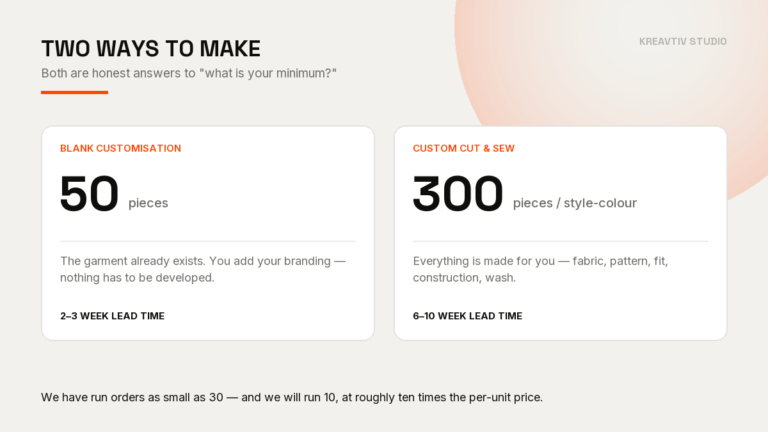
Garment dyeing has its own economics. Dye machines run efficiently at certain load sizes, so many dye houses set a minimum per colour, and small colour splits can cost more per piece. Washes such as acid and stone also add handling time and a separate process step. Plan for:
- Colour count. Fewer colours with deeper quantities are easier to dye consistently than many colours in small amounts.
- Extra time. Lab dips, wash development and shrinkage testing add rounds before bulk. Build them into the calendar.
- Overages. Wash and dye processes produce some seconds. Discuss allowances at the quote stage.
- Reorders. A reorder is a new batch. Keep your approved standards so the next run is matched to the same reference.
Minimums, lead times and pricing depend on fabric, colour and process, and are confirmed with your quote. The fastest way to reach a reliable number is to bring a reference garment or colour standard to sampling.
Working with a studio on dyed and washed product
Dye and wash decisions are easiest to get right when they are made early, alongside fabric and pattern, rather than added at the end. If you are planning garment-dyed or washed product, send us your references, colours and quantities through the estimate form. Minimums, timelines and costs are confirmed with your quote.