
Every December, someone in an office gets handed a task that sounds simple: get branded clothing made for the team.
It is not simple. Within a week they have discovered that the local print shop wants 30 of one design, the online platforms cannot do a custom label, the prices vary wildly, and nobody will confirm whether anything can arrive before the Christmas break.
This is written for that person, by a manufacturer in Lahore who does this work for companies in the United States, the United Kingdom and Australia. Where the answer differs between those three markets, it says so – because a UK large is not a US large, and a duty rate that is friendly in London can be less friendly in Sydney.
It contains real numbers, real minimums and real lead times. The guessing is what wastes everyone’s time.
Short answer
Corporate merchandise is branded clothing a company orders for staff, clients, events or resale. Order it as blank customisation from 50 pieces (2–3 weeks) or as custom cut and sew from 300 pieces per style-colour (6–10 weeks). Staff apparel that is worn daily should be embroidered polos or mid-weight tees; client gifting should be a smaller run of heavyweight hoodies. Most corporate orders fail because the buying calendar is left too late, not because the garment is wrong.
| What you are ordering | Best garment | Decoration | Typical minimum |
|---|---|---|---|
| Staff apparel (daily wear) | Polo or 200–240 GSM tee | Embroidery | 50 pieces |
| Client gifting | Heavyweight hoodie or fleece | Embroidery or woven label | 50 pieces |
| Conference or event | Mid-weight tee | Screen print | 50 pieces |
| Retail or resale merch | Custom cut and sew | Full custom branding | 300 per style-colour |
What counts as corporate merchandise
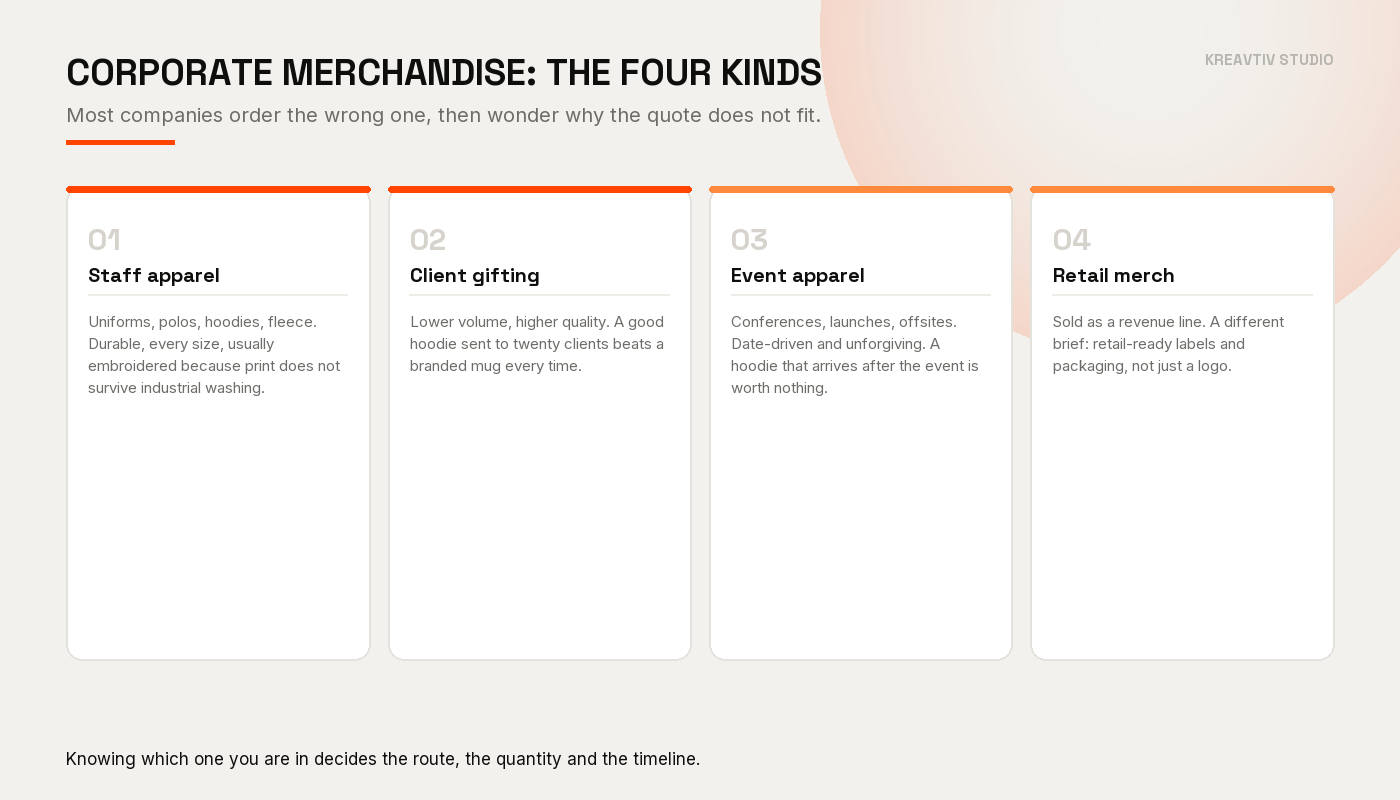
The term covers more than logo t-shirts, and knowing the categories makes quoting much easier.
Staff apparel. Uniforms, polos, tees, hoodies, fleece jackets. Usually needs to be durable, washable, and available in every size your team wears. Often needs to handle embroidery rather than print, because embroidery survives industrial laundering and print does not.
Client and gifting apparel. Higher quality, lower volume. A well-made hoodie or fleece sent to twenty key clients does more than a branded mug. This is where the festive season matters most.
Event apparel. Conferences, launches, team offsites, trade shows. Usually one-off, date-driven, and unforgiving on timing. A conference hoodie that arrives after the conference is worth nothing.
Retail and resale merch. Some companies sell merch as a revenue line, particularly brands with a community. This is a different brief entirely – it needs retail-ready packaging and labels.
Knowing which category you are in determines the route, the quantity and the timeline.
The minimum order problem
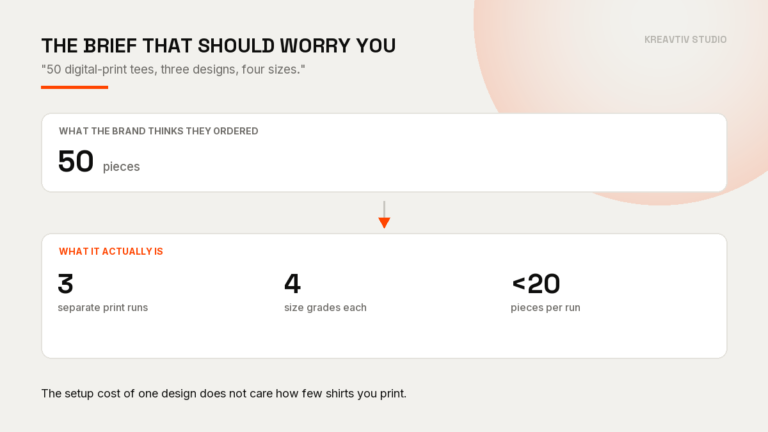
Most companies discover the same thing: the place that prints t-shirts locally will not print fewer than 30 of a single design, and the place that can do a custom label or a custom colour will not talk to you under 300.
That is not a trick. Printing and dyeing have real setup costs, and those costs have to be spread across the order.
The same is true of almost every clothing manufacturer you will contact. Small batch apparel manufacturing is possible, and low MOQ work is real – but every supplier has a floor below which the fixed costs stop making sense. Ours is 50 pieces on blank customisation.
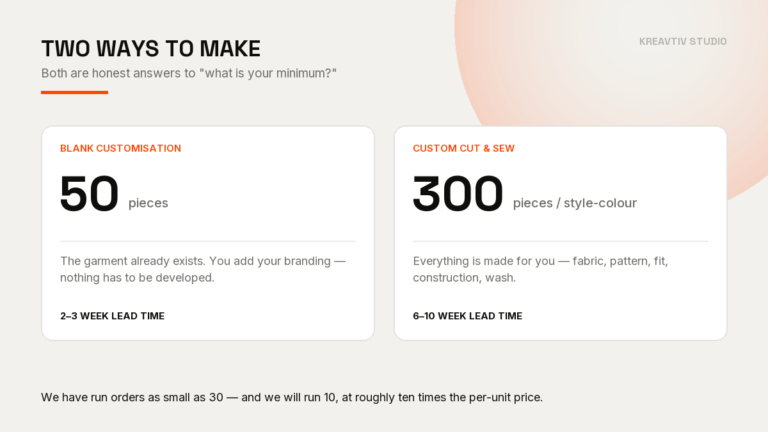
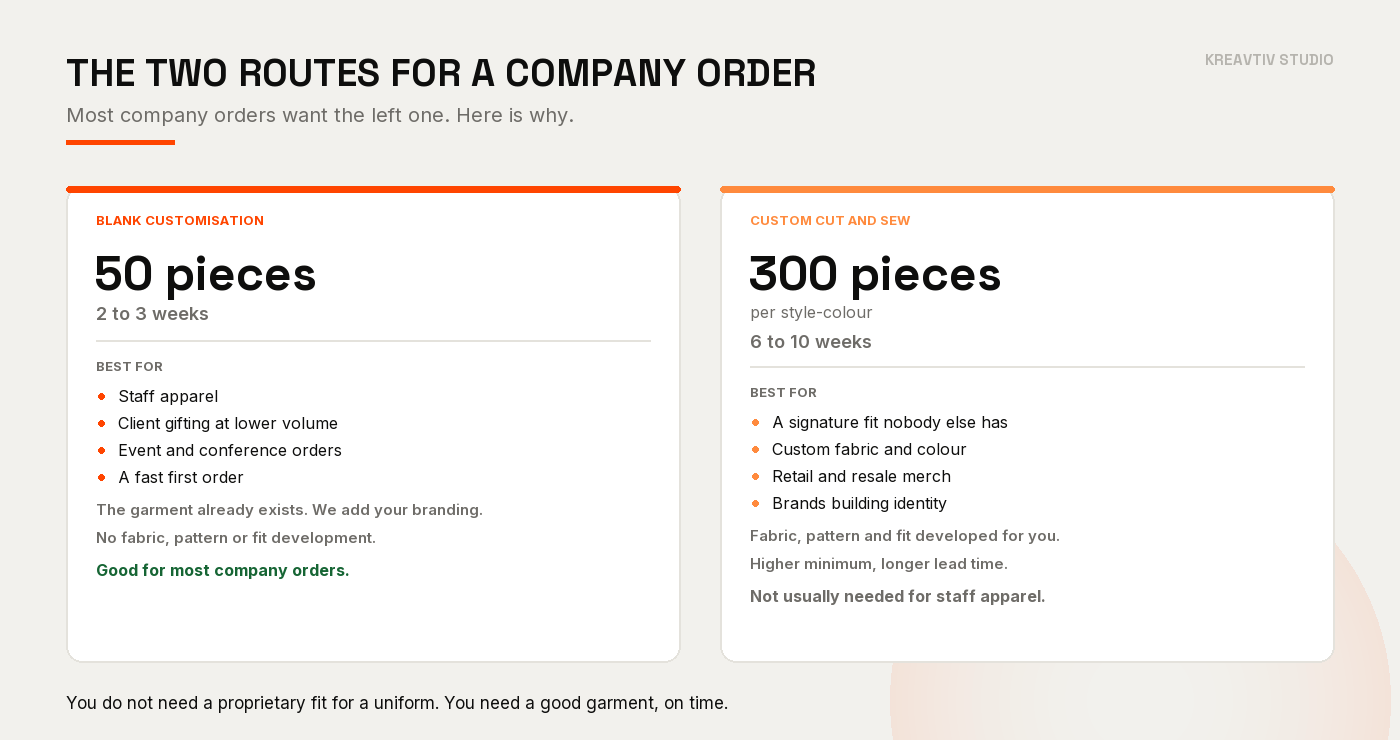
Our published minimums are 50 pieces for blank customisation and 300 pieces per style-colour for custom cut and sew. Blank customisation means we apply your branding to a garment that already exists. Custom cut and sew means we develop the fabric, pattern and fit for you.
For most company orders, blank customisation is the right route. You do not need a proprietary fit for staff apparel. You need a good garment, your logo on it, and it to arrive on time.
If you have been searching for custom logo shirts with no minimum or no minimum custom polo shirts and finding nothing real, this is why: a genuine factory has setup costs it cannot pretend away. What we can do is get to 50 on an embroidered polo, and to 30 on some garments, which is as close to “no minimum” as apparel manufacturing honestly gets.
Worth knowing: we have run orders as small as 30 pieces, and we run 10-piece development runs at roughly ten times the bulk per-unit price. If you genuinely need three samples for a board meeting before you commit, that is possible – it is just priced accordingly, because the fixed costs do not shrink.
What it costs
We are not going to publish a single price, because it would be misleading. But we will show you exactly how a price is built, so you can read any quote you receive and know which line to question.
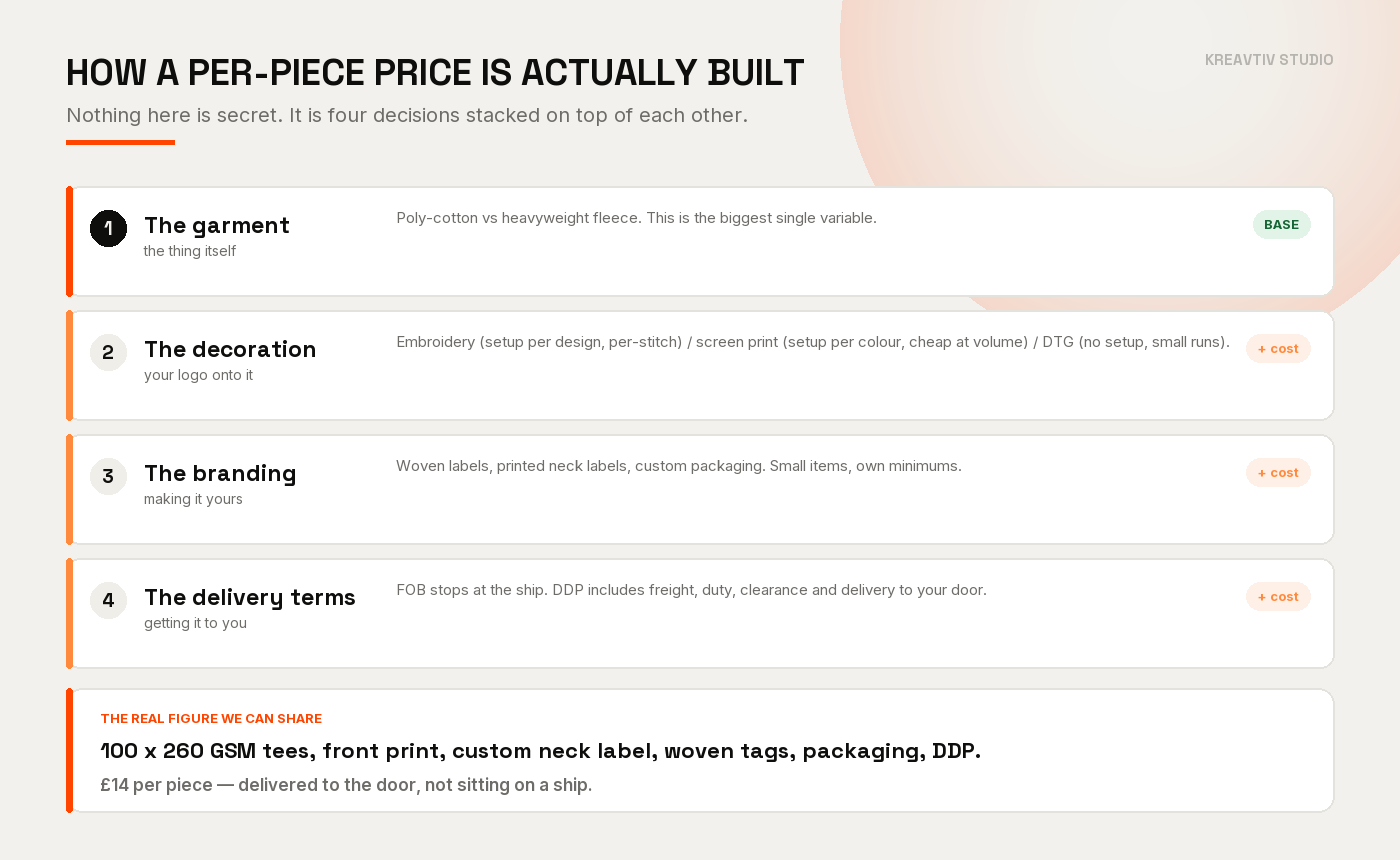
Four decisions stack on top of each other. Any custom corporate t-shirt or branded workwear quote you receive is these four decisions, stacked. Change any one and the number moves.
1. The garment. A basic poly-cotton polo and a heavyweight fleece jacket are not the same product. Weight and fabric quality are the single biggest variable – a 180 GSM tee and a 260 GSM tee can differ by more than everything else on this list combined.
2. The decoration. Embroidery has a setup cost per design and a per-stitch cost, and it is the right choice for staff apparel because it survives industrial laundering. Screen printing has a setup cost per colour and becomes very cheap at volume. DTG has no setup and suits small runs of detailed artwork. If your logo has six colours, screen printing that logo six times is not the same job as embroidering it once.
3. The branding elements. Woven labels, printed neck labels, custom packaging. Individually trivial, and they carry their own minimums, so they land hardest on a small first order. This is often why a 50-piece quote looks worse per piece than a 300-piece one – the labels cost almost the same either way.
4. The delivery terms. This is the line most companies misread, and it is the one that changes the number the most. A quote that says FOB gets the goods onto a ship; everything after that – freight, duty, clearance, the last mile – is yours. A quote that says DDP includes all of it and delivers to your door. Ask for the DDP number. It is the only one you can compare against another supplier.
Two suppliers can be thousands of pounds apart on paper and identical in reality, purely because one quoted FOB and one quoted DDP. If you want the detail, we explain why a factory quotes the way it does.
The real figure we can share. A recent 100-piece run of 260 GSM t-shirts with a front print, custom neck label, woven tags and packaging, delivered duty paid, came to £14 per piece. That is a real order, not an estimate. Take the same order and make it 180 GSM, drop the labels and ship it FOB, and it gets cheaper. Make it a heavyweight fleece with embroidery and custom packaging, and it goes up. Now you know which lever you are pulling.
How long it takes
This is where festive orders go wrong, so read it carefully.
Blank customisation: 2 to 3 weeks from approval. This is decoration and finishing on a garment that already exists.
Custom cut and sew: 6 to 10 weeks from approval. Fabric, pattern, fit, sampling, then production.
Neither number includes the time you spend deciding. And neither includes Christmas.
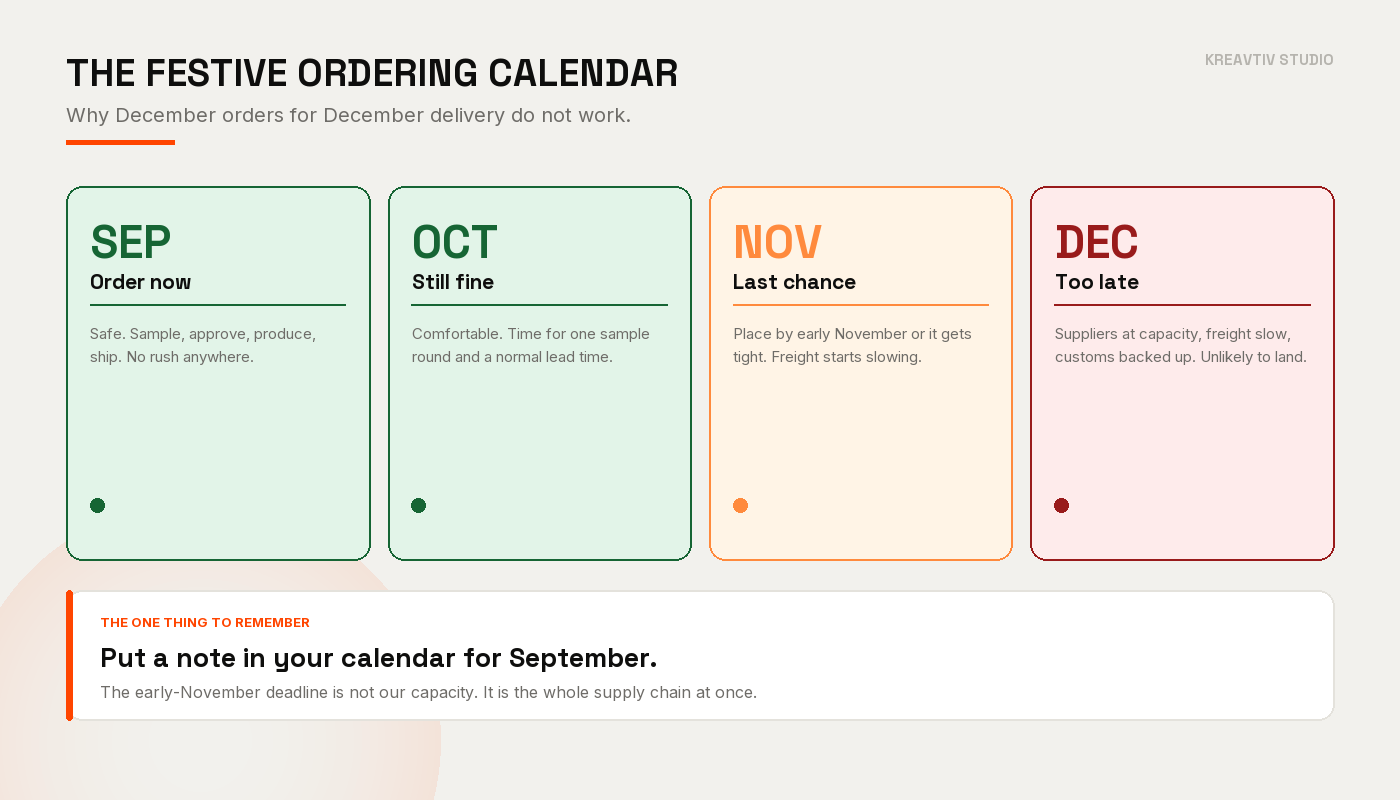
If you want festive delivery, place the order by early November. That deadline has nothing to do with our capacity. It is the whole supply chain at once, and it reaches capacity at the same time every year.
The annual crunch is real. From early November, every apparel supplier in every country is at capacity. Freight gets slower and more expensive. Customs backlogs grow. An order placed on 1 December for delivery before Christmas is not a lead time problem – it is a bad plan.
How this differs in the US, UK and Australia
If your team is spread across those three markets, several things change. These are the differences that actually bite, not the ones that look good on a supplier’s website.
Sizing is the first trap. A US large is not a UK large, and an Australian large is not either. US sizing runs roughly one size generous against UK sizing, and Australian workwear often sits between the two. Collect a real size run from the people who will wear the garments. Do not assume, and do not let a supplier assume for you.
Duty and landed cost differ by market. The UK operates the Developing Countries Trading Scheme, which gives Pakistani garment exports preferential tariff treatment on a large number of categories. The US does not offer Pakistan the same generalised preference, so US-bound orders frequently attract a higher effective duty. Australia sits somewhere in between and depends heavily on the HS code. Ask about the specific HS code for your garment rather than assuming you will be charged the headline rate – and always ask for a delivered duty paid quote, because FOB and DDP are not comparable numbers.
Buying calendars are not the same. In the US, corporate apparel ordering peaks around end-of-year gifting and again before summer. In the UK, the festive crunch in November and December is the hardest deadline of the year, and the summer event season sits behind it. In Australia the festive season is the same calendar month but the middle of summer, so nobody is ordering heavyweight fleece for December – they are ordering it in May. If you are ordering for teams in more than one of these markets, your deadline is the earliest of the three, not the average.
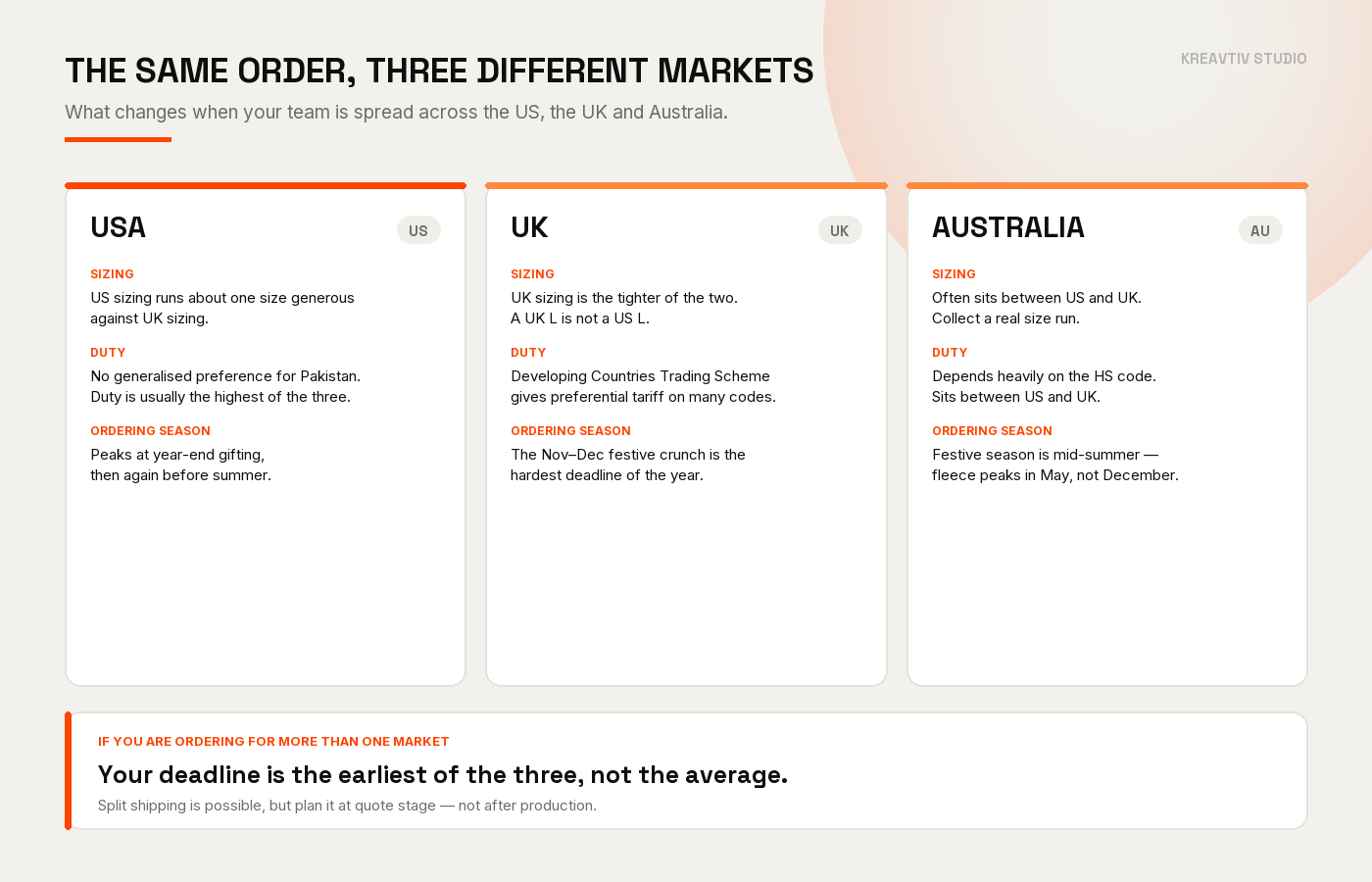
Split shipping is possible, but plan it at quote stage. You do not have to send everything to one address. Goods can ship to the US, the UK and Australia separately, but it affects freight cost and it has to be decided when you ask for the quote, not after production has finished.
One order, one design, three markets is usually cheaper than three separate orders – unless the designs genuinely differ, in which case it is three orders with three setup costs, three shipping charges and three sets of paperwork.
What you should actually order
Most people arrive here wanting one of four garments and not sure which. Here is the short answer, by situation.
If it is staff apparel that gets worn daily: order polos or mid-weight tees, embroidered. Embroidery survives washing, printing does not, and a 200–240 GSM cotton or poly-cotton handles a working week. Polos read more formal than tees without being a uniform, which matters more than people expect when you are handing clothing to adults.
If it is client gifting: order a heavyweight hoodie or fleece, and order fewer of them. Twenty good hoodies outperform a hundred thin tees, because the client keeps the good one. This is the one category where spending more per piece is the correct decision.
If it is a conference or an event: order mid-weight tees with a screen print. They are cheap at volume, they are fast, and attendees actually wear them. Do not order heavyweight fleece for an event unless the event is outdoors in winter – you will pay for weight nobody wanted.
If it is merch you intend to sell: order cut and sew, and budget for proper labels and packaging. A garment sold to a customer has to survive retail scrutiny. This is the only situation where the higher minimum is genuinely the right route.
Embroidery or print? Embroidery for anything washed repeatedly and anything that touches a client. Print for anything with fine detail, gradients or many colours, and anything on a tight deadline or a small quantity. If you are unsure, send us your logo and we will tell you which one it survives.
And if you truly do not know: order one garment. See the fabric, feel the weight, check the embroidery. Almost every mistake in this category is discovered first by the person who ordered forty without ever holding one.
What to send when you enquire
You do not need a finished tech pack to start. You will get a far better answer if you bring these:
- What you want – garment types and roughly how many styles.
- How many – even a range. It decides whether blank customisation applies.
- Your artwork – a logo file, ideally a vector.
- Delivery countries – this affects duty and freight.
- A date you actually need it – a launch, an event, a festive break. Not “soon”.
- Any reference garments – a hoodie you like the fit of tells us more than a paragraph.
That is enough for a manufacturer to tell you whether your idea works at your quantity and your date. That is the most useful thing you can learn early.
What we will not do
We will not quote without knowing the specification, because we would have to change the number later, and that wastes your time.
We will not tell you the minimum is lower than it is. 50 pieces for blank customisation, 300 per style-colour for custom cut and sew.
And we will not promise a festive delivery date we cannot control. If you come to us in December wanting a Christmas delivery, we will tell you it is unlikely rather than take the order and disappoint you.
Planning ahead for next year
If this year’s window has closed by the time you read this, the useful thing is to plan the next one properly.
The companies that get their festive merch right order in September or October, not November. That gives time for a sample, time to approve it, time for production, and time for freight before the entire world’s supply chain congests.
Put a note in your calendar for September. That is the single most useful thing in this article.
Our estimate calculator will give you a starting range from your specification, and the production process explains how an order runs from first contact to shipment. If you want to see the garment before committing, ask about a sample – it is the cheapest money you will spend.
We work with companies in the US, the UK and Australia on custom corporate apparel and company logo workwear, from 50 pieces up. Send your logo, your quantity and your delivery country, and we will tell you straight away whether it works at your date.