
Screen printing, DTF, DTG and embroidery all put a logo on a garment, but they behave differently on the body, in the wash and on your costing sheet. Choosing the wrong one usually shows up late: a heavy plastic-feeling transfer on a lightweight tee, an embroidery that puckers thin jersey, or a print that cracks after a few washes. This guide sets out how each method works, where each one fits, and how to specify decoration so the sample and the bulk match.
How each decoration method works
Screen printing
A stencil is made on a fine mesh screen, one screen per colour. Ink is pushed through the open areas of the mesh onto the garment, colour by colour, and then cured with heat. The two common ink families are plastisol, which sits on top of the fabric and gives bright, opaque colour, and water-based ink, which soaks into the fibres for a softer feel. Screens and setup take time, so the cost is front-loaded and spread across the run.
DTF (direct to film)
The design is printed with colour and white ink onto a PET film, coated with a hot-melt adhesive powder, cured, and then heat-pressed onto the garment. The film is peeled away, leaving the print bonded to the surface. There is no screen per colour, so full-colour artwork costs the same to set up as a one-colour logo.
DTG (direct to garment)
An inkjet printer prints water-based ink directly onto the garment. On dark garments a pretreatment and a white underbase are needed. DTG gives fine detail and a soft hand, and it performs best on high-cotton fabrics.
Embroidery
The artwork is digitised into a stitch file that tells the machine where each stitch goes, then sewn with thread onto the garment over a stabilising backing. It is raised, textured and very durable, and it reads as premium on caps, fleece and heavier knits.
Puff print and other specialist finishes
- Puff print. A screen-printing ink with a puffing additive that expands when cured, giving a raised, soft, rubbery effect. A puff print hoodie works because the heavy fleece supports the raised ink.
- Discharge. A discharge agent removes the dye from the fabric and replaces it with colour, so the print has almost no hand. It works on reactive-dyed cotton; it does not work on polyester, and results vary by dye and colour, so it always needs testing.
- High-density. Thick plastisol printed through thick stencils, giving sharp, raised edges.
- Chenille and appliqué. Chenille is a looped, towel-like yarn stitched into patches or letters. Appliqué is a piece of fabric stitched onto the garment, often edged with embroidery. Both suit varsity and heritage styles.
Screen printing vs DTF vs DTG vs embroidery: comparison table
| Screen print | DTF | DTG | Embroidery | |
|---|---|---|---|---|
| Setup | Screen per colour; highest setup | Low; no screens | Low; no screens | One-off digitising per design |
| Colours | Each colour adds a screen; best for spot colours | Full colour and gradients | Full colour and photographic detail | Limited by thread changes; no true gradients |
| Feel | Soft (water-based) to thick (plastisol) | Smooth, slightly film-like layer | Soft, absorbed into fabric | Raised and textured |
| Durability | Very good when correctly cured | Good; edges can lift if pressed badly | Fair to good; can fade with washing | Excellent |
| Best run size | Medium to large | One-offs to medium runs | One-offs and small runs | Any, but stitch count drives cost |
| Fabrics | Cotton, blends and polyester with the right ink | Cotton, polyester, blends, nylon | Best on high-cotton | Most fabrics; needs support on light jersey |
The table is a general guide. Ink systems, machines and operator skill vary widely, so the same method can perform differently between suppliers. Confirm by sampling on your actual garment.
DTF vs DTG: which one?
Both are digital, so both suit short runs and full-colour artwork. The main differences:
- Fabric. DTF bonds to a wide range of fibres, including polyester and blends. DTG prefers cotton.
- Hand. DTG is absorbed into the fabric and feels softer, especially on light garments. DTF sits on top as a thin layer, which is noticeable on large solid areas.
- Brightness on dark garments. DTF gives strong colour on dark fabrics because the white layer is printed into the transfer. DTG needs pretreatment, which can leave a visible mark that washes out.
- Logistics. DTF transfers can be printed ahead and pressed later. DTG prints each garment directly.
DTF has grown quickly. A DecoNetwork industry overview describes it as filling the gaps where screen printing struggles with shorter runs, while noting that screen printing remains the go-to choice for large-volume orders. That is a useful way to think about it: the methods sit side by side rather than one replacing the other.
Best printing method for small batches
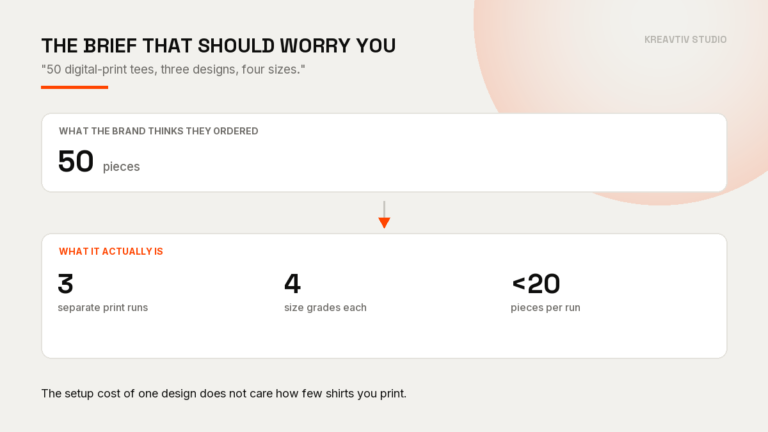
For roughly under 100 pieces per design, setup cost matters more than unit cost. General guidance:
- Full-colour artwork, small run: DTF or DTG. No screens, so many colours do not add setup.
- One or two spot colours, small run: screen printing can still make sense if the handfeel matters, but the setup is spread over few pieces. DTF is the practical alternative.
- Small logo, premium feel: embroidery. Digitising is a one-off, and small chest logos have modest stitch counts.
- Several designs or sizes of artwork across a small drop: digital methods avoid setting up screens for every version.
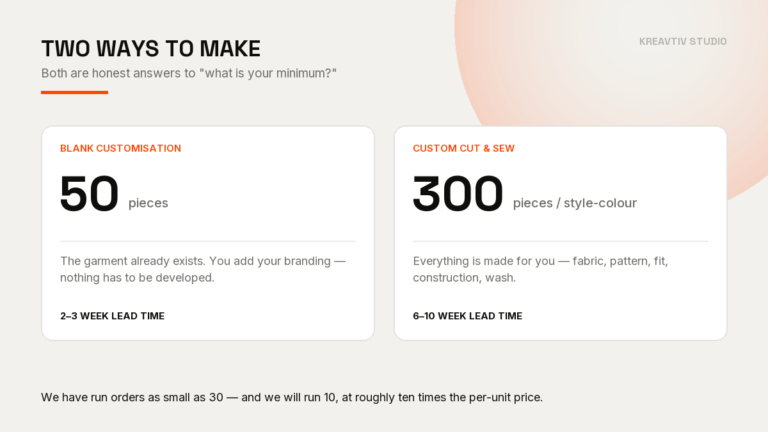
At volume the picture changes. Once a design runs into the hundreds and above, screen printing’s setup is spread across many pieces, its per-piece speed is high, and it gives the most control over ink feel and colour matching. Embroidery stays viable at any volume, but cost follows stitch count and size. Prices depend on the artwork, garment and quantity and are confirmed with your quote; see blank customisation for decoration on ready-made blanks.
Embroidery vs screen printing
This is often a brand decision rather than a technical one. Embroidery is raised, textured and reads as premium; it handles small logos, caps and heavy fabrics very well, but it cannot reproduce gradients or fine detail and large designs become stiff and heavy. Screen printing handles large graphics, fine linework and exact spot colours, and on a soft water-based ink it disappears into the fabric. A common pattern for a range is embroidery on fleece and caps for the logo, and screen print or DTF for the graphic tees.
How decoration interacts with fabric weight and garment dye
- Lightweight jersey puckers under dense embroidery and can feel weighed down by large DTF or plastisol areas. Use smaller embroidery with appropriate backing, or water-based print.
- Heavyweight fleece and knits support embroidery, puff and high-density well. Brushed or looped surfaces may need a water-soluble topping for crisp embroidery and a heavier ink deposit for prints. Decoration on sweaters and other knits is covered in knitwear development.
- Stretch fabrics need inks and transfers that stretch, or the print will crack.
- Garment-dyed and washed product. Decoration applied before dyeing goes through the dye bath: prints are overdyed, polyester embroidery thread stays its colour, and heavy washes can crack prints and fluff stitches. Decoration applied after dyeing keeps its colour but must suit the softened, shrunk fabric. Discharge depends on the dye used, so it needs testing on garment-dyed bases.
- Polyester and performance fabrics can let dye migrate into light inks during curing, staining a white print. Low-cure or blocker inks are used to prevent this.
Durability and care testing
Decoration should be approved after washing, not just off the press. Before bulk:
- Wash test the sample. Wash it several times on the care label settings, then check for cracking, peeling, fading, edge lift and puckering.
- Stretch test prints on knits, especially at the edges of large solid areas.
- Rub test for colour transfer from prints and pigment-dyed bases.
- Check the care label matches what the decoration can take: inside-out washing, cool iron, no tumble dry if needed.
- Use recognised methods where it matters. For retail programmes, ask for testing to standard methods for colourfastness and dimensional stability so results are comparable between suppliers.
Final inspection should include decoration placement, size and finish against the approved sample; see garment finishing and quality.
Putting decoration in the tech pack
Decoration is one of the most common gaps in a tech pack. For each placement, specify:
- Method and ink or thread type (for example, water-based screen print, puff, DTF, flat embroidery).
- Exact placement: distance from a fixed point such as the high point shoulder or centre front, measured in the finished garment.
- Artwork size, and whether it scales by size or stays fixed across the range.
- Colours with Pantone or thread references, and the garment colours each version is used on.
- Sequence: before or after garment dye or wash.
- The approved strike-off or sample as the standard.
Artwork file requirements
- Screen printing: vector artwork (AI, EPS, PDF or SVG) with text outlined, colours specified as Pantone references, and one colour per separation.
- DTF and DTG: high-resolution raster files, typically 300 dpi at actual print size, as PNG with a transparent background. Avoid semi-transparent edges unless you want them printed.
- Embroidery: clean vector or high-resolution artwork for digitising, plus thread colour references. Very fine lines and small text lose definition, so ask the digitiser for their minimums before you finalise the logo.
- All methods: the final print size in centimetres or inches, and a mock-up showing placement.
A decoration sample, or strike-off, is approved during sampling, ideally on the actual garment in the actual colour.
Working with a studio on decoration
The right decoration depends on fabric, quantity, artwork and how the garment is finished, so it is best decided with the rest of the product rather than at the end. Send your artwork, garment references and quantities through the estimate form. Methods, minimums and pricing are confirmed with your quote.