

Heavyweight is the most requested fabric direction for tees and hoodies right now, and also the most loosely used word on a spec sheet. One supplier’s heavyweight is another’s midweight. The only way to compare fabrics, quote accurately and get the sample you pictured is to talk in GSM, and to understand what GSM does and does not tell you.
Demand is not just a retail streetwear story. Custom Ink’s 2026 Swag Trends Survey of more than 1,000 corporate buyers reported that 62% planned to include heavyweight tees and fleece in upcoming campaigns, and 46% said they prefer boxy cuts for T-shirts and outerwear (trade coverage of the survey). It is a vendor survey of promotional buyers rather than retail consumers, but it points the same way as the retail market: fewer, better, heavier pieces that people keep wearing.
This guide covers what GSM measures, the approximate weight bands for tees and hoodies, how boxy and drop-shoulder fits interact with heavy fabric, the shrinkage and torque problems that come with 300 GSM jersey, and when a heavyweight blank is enough versus when the fabric needs developing.
What does GSM mean for a t-shirt or hoodie?
GSM is grams per square metre: the mass of one square metre of the finished fabric. A higher number means more fibre in the same area, which usually reads as a denser, more opaque, more structured garment. It is a weight, not a quality grade.
US blank catalogues often quote weight in ounces per square yard instead. To convert, multiply oz/yd² by roughly 33.9. A 6.5 oz tee is about 220 GSM; a 10 oz fleece is about 340 GSM. Some catalogues quote weight per linear yard instead of per square yard, which is not comparable, so always ask which unit is meant.
Two fabrics at the same GSM can feel completely different. Yarn count, fibre (combed ring-spun cotton versus open-end), knit structure, compaction and finishing all change the handfeel, drape and recovery. GSM is the first number on the fabric spec, not the only one.
How is fabric GSM measured?
The standard method is simple. A circular cutter punches a swatch of known area, commonly 100 cm², the swatch is weighed on a precision scale and the result is scaled up to a square metre. Formal test methods such as ASTM D3776 set out how samples are taken and conditioned so results are repeatable.
Three checks worth building into your process:
- Measure finished fabric. Greige (unfinished) fabric changes weight through dyeing, compacting and brushing. The GSM in your tech pack should be the finished, washed-and-dried weight.
- Take several swatches. Cut from different points across the width and along the roll, and average them. One swatch can be misleading.
- Set a tolerance. Specify a target and a range, for example 280 GSM ±5%. Without a tolerance, a fabric that comes in noticeably lighter is still arguably “to spec”.
What GSM is a heavyweight t-shirt?
There is no official cut-off, but the market broadly agrees on the bands below. Treat them as approximate; suppliers draw the lines slightly differently.
| T-shirt weight | Approx. GSM | Approx. oz/yd² | What it feels like |
|---|---|---|---|
| Lightweight | Under 150 | Under 4.5 | Soft, drapey, can be slightly sheer in light colours |
| Midweight | 150-190 | 4.5-5.5 | The everyday retail and promotional tee |
| Heavyweight | 200-250 | 6-7.5 | Opaque, holds its shape, the classic “premium” tee |
| Extra heavyweight | 250-300+ | 7.5-9+ | Dense and structured, stands away from the body, streetwear territory |
Most brands asking for a heavyweight tee are aiming for somewhere between 220 and 280 GSM. Beyond about 300 GSM, single jersey starts to behave less like a tee and more like a light sweatshirt, and the production risks covered below increase.
Hoodie GSM chart: light, mid and heavyweight
Hoodies and sweatshirts are usually made in fleece (loopback brushed on the inside) or French terry (loopback left unbrushed). Their weight bands sit well above tees:
| Hoodie weight | Approx. GSM | Approx. oz/yd² | Typical use |
|---|---|---|---|
| Lightweight | 200-280 | 6-8 | Layering, warm climates, summer French terry |
| Midweight | 280-350 | 8-10 | Most retail and merch hoodies |
| Heavyweight | 350-450 | 10-13 | Premium and streetwear hoodies, structured hood |
| Extra heavyweight | 450+ | 13+ | Statement pieces; very warm, stiff when new |
Remember that rib trims (cuffs, hem, sometimes the hood lining) are specified separately. A 400 GSM body with a thin rib looks unfinished; the rib usually needs to be heavier and firmer to match.
Boxy vs regular fit: what changes in the pattern?
Heavyweight fabric and boxy fits go together because heavy jersey has the body to hold a wide, square silhouette. On a 160 GSM fabric the same pattern collapses and just looks oversized. The pattern changes matter as much as the fabric:
- Dropped shoulder. The shoulder seam sits below the natural shoulder point, often by several centimetres. The shoulder slope is flattened and the sleeve cap is shallower, so the sleeve hangs from the body rather than from the shoulder.
- Wider, shorter body. A boxy tee is typically wider across the chest and shorter in body length relative to a regular fit, which is what gives the square proportion. Grade the width and length deliberately; boxy does not mean every point of measure is simply larger.
- Deeper armhole. The armhole drops with the shoulder. Measure it straight, not curved, and specify it in the tech pack.
- Sleeve length from the seam. Because the seam has moved, sleeve length measured from the shoulder seam is shorter than on a regular tee even though the sleeve finishes in a similar place on the arm.
- Heavier neck rib. A heavyweight body needs a firmer, often wider neck rib, set with enough tension to lie flat without rippling.
Whether you are working from a reference garment or a new block, write these points down. Our free t-shirt tech pack template and hoodie tech pack template include points of measure for shoulder drop, armhole and rib heights, so the fit is specified rather than described.
300 GSM tees: shrinkage, torque and other problems
Very heavy single jersey is harder to make well than it looks. The issues to plan for:
- Shrinkage. Dense cotton jersey can shrink significantly in length if it is not properly compacted or pre-shrunk. Agree a maximum shrinkage figure (many brands work to a limit in the region of 3-5% after washing) and test the bulk fabric, not just the sample yardage. If the garment will be garment-dyed or washed, grade the pattern to allow for the expected shrinkage.
- Torque (spirality). Single jersey has a natural tendency to twist, and the side seams spiral round to the front after washing. It comes from yarn twist and knitting, and is made worse by heavier yarns and poor finishing. It is controlled through yarn selection, open-width compacting and cutting on grain. Wash-test the sample and check the side seams before approving.
- Neck and seam bulk. Heavy fabric makes thick seams. Overlocked seams, cover-stitched hems and the neck rib join need machine settings adjusted, or the neckline stretches and the hems wave.
- Stiffness. 300 GSM can feel boardy when new. A softener, enzyme wash or garment wash brings the handfeel back, but each changes shrinkage and colour, so finish the sample the same way bulk will be finished.
Heavyweight blank or custom-developed fabric?
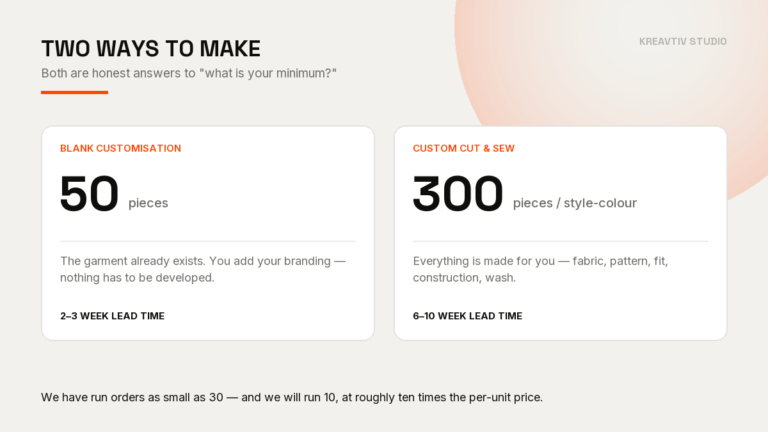
There are good heavyweight blanks on the market, and for many brands they are the right starting point. Blank customisation gives you a proven fabric and fit; you add print, embroidery, labels and packaging. The trade-off is that you choose from what exists: the weight, fit, colour palette and handfeel are the blank’s, and so is the look your competitors can buy too.
Developing the fabric makes sense when the fabric is the product:
- You want a specific GSM, yarn or composition, such as a 280 GSM combed cotton jersey with a dry, compact handfeel.
- You want a custom colour, which means lab dips and dyeing to your standard.
- You want your own boxy block rather than a blank’s fit.
- You need tighter control of shrinkage and torque than a blank’s spec guarantees.
That route runs through yarn and fabric selection and knitwear development: specifying yarn count and fibre, knitting and testing a trial, then approving the finished GSM, shrinkage and colour before bulk. It takes longer and involves more commitment, but the result belongs to your brand.
Common mistakes when specifying heavyweight
- Writing “heavyweight” without a number. Always specify GSM, composition and tolerance.
- Confusing units. Mixing oz per square yard with oz per linear yard, or greige with finished weight.
- Copying a fit onto a different fabric. A pattern that works at 180 GSM will not hang the same at 280 GSM. Re-sample when the fabric changes.
- Skipping the wash test. Shrinkage and torque only show up after washing. Approve samples after a wash, not straight off the machine.
- Forgetting the trims. Rib weight, neck tape and labels need to suit a heavier body.
Working with a studio
If you know the weight and fit you want, put them in a tech pack and get both the blank route and the developed-fabric route priced. Minimum quantities, lead times and pricing depend on the fabric and are confirmed with your quote. You can start with the estimator, which suggests a route based on your answers.