
Most founders start looking for a factory too early. They send the same vague email to thirty manufacturers, get back a handful of replies with wildly different prices, and cannot tell which one is right because none of the quotes are for the same thing. Learning how to find a clothing manufacturer is mostly learning how to ask a precise question – and that starts before you contact anyone.
What do you need before you contact a clothing manufacturer?
A factory quotes on what you send it. If you send a mood board, you get a guess. If you send a complete specification, you get a price you can compare. Before you start outreach, be honest about where your product sits:
- Idea only. You have references and a feeling for the product. You need design and development help, not a production line yet.
- Sketches and a fabric direction. You can describe the garment, but nothing is measured. You need a tech pack and a pattern.
- A complete tech pack. Flat drawings, a measurement chart with tolerances, a bill of materials, construction notes and artwork placements. You are ready to request comparable quotes.
- An approved sample. You have a garment that fits and a pattern that works. You are ready to talk bulk.
If you are at the first two stages, the tech pack is the document that makes every later conversation shorter. Our tech pack templates show the minimum a factory needs to see, including a checklist for finding the gaps before a manufacturer does.
You should also know your rough quantities per style, your target retail price, and the landed cost you can afford. A factory that hears “about 300 units, retail around 80, two colours” can tell you in one reply whether you are a fit.
Full package vs CMT vs FOB: which manufacturing model do you need?
The three terms describe how much of the job the factory takes on – and therefore how much you must organise yourself. They are used loosely, so always confirm in writing what a quote includes.
| Model | Who sources fabric and trims | Who carries the most risk | What you must supply |
|---|---|---|---|
| CMT (cut, make, trim) | You. The factory receives your fabric and trims and cuts, sews and finishes. | You carry material risk: shortages, late fabric, shade variation and fabric faults are yours to manage. | Graded patterns or a full tech pack, all fabric and trims delivered on time, labels and packaging. |
| FOB (as used in apparel) | The factory buys materials to your specification and delivers finished goods. | The factory carries material and production risk up to the agreed delivery point. | An approved tech pack and sample, colour and fabric approvals, a purchase order. |
| Full package | The manufacturer handles development and sourcing, often including patterns, sampling and sometimes design support. | Mostly the manufacturer, but you depend on their judgement and development skill. | A clear brief, decisions on time and sign-off at each approval stage. |
A note on CMT vs FOB: in apparel, “FOB” is shorthand for “the factory buys the materials”. Strictly, FOB is an Incoterm – under the ICC’s rules, the seller delivers the goods loaded on board the vessel nominated by the buyer, and risk passes to the buyer at that point (ICC Academy). A quote can be “FOB” in both senses at once, so check whether the price covers freight, duties and insurance, or stops at the port. Getting that side of the order right is export and logistics.
As a rule of thumb, CMT gives you more control and more work. Full package gives you less work and less visibility. First-time brands without sourcing experience often find a full-package or development-led partner saves more than it costs, because mistakes in material sourcing are the expensive ones.
Where to look for a clothing manufacturer
No single channel is best. Each has a different signal-to-noise ratio.
- Trade shows. Fabric and sourcing fairs let you handle fabric, meet the people who will run your order and compare many suppliers in a few days. The downside is cost and timing: travel adds up, and exhibitors are often focused on larger buyers.
- Directories and sourcing databases. Useful for building a long list by product category and capability. Listings are self-reported, so treat certifications and capacity claims as things to verify, not facts.
- Referrals. The best leads usually come from pattern cutters, fabric agents, freelance technologists and other founders. A referral tells you how a factory behaves when something goes wrong, which no listing can.
- B2B marketplaces. Fast and searchable, with many suppliers willing to quote small orders. Quality varies enormously, and many sellers are traders rather than the factory itself.
- Development studios. If you are not ready for production, a studio that covers design, patterns, sampling and production coordination can take you from tech pack to bulk without you managing several suppliers.
Red flags to watch for
- A price quoted before they have seen a tech pack or asked about fabric.
- No questions about your measurements, fabric weight or construction.
- Reluctance to show a sample of their own work or let you speak to the production manager.
- Pressure to pay the full amount up front, or to pay into a personal account.
- Vague answers about who actually sews the garments, or whether work is subcontracted.
- “Any MOQ, any fabric, any lead time” – nobody can genuinely promise all three.
What does MOQ mean in clothing?
MOQ stands for minimum order quantity: the smallest order a factory will accept. The detail founders miss is what the minimum applies to. It can be set:
- Per style – e.g. a minimum number of hoodies in total.
- Per colour – each colourway must reach the minimum on its own.
- Per size – less common, but some factories set a floor per size in each colour.
So a factory with a per-colour minimum effectively doubles your order when you add a second colour. Ask which one applies before you plan a range.
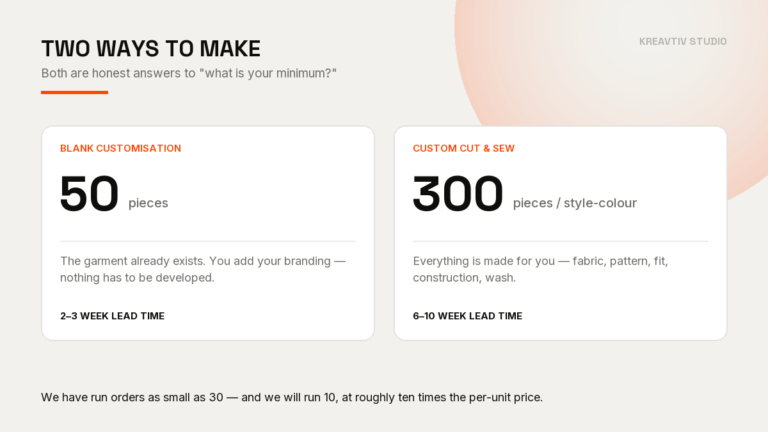
Fabric usually drives the minimum more than sewing does. Mills dye and knit or weave in batches, and a custom colour or construction has its own minimum length. If one style needs a full dye lot, the garment MOQ follows the fabric. Stock fabrics, open-stock colours and customised blanks are the usual ways to start smaller.
10 questions to ask a clothing manufacturer
- What garment types and fabrics do you produce most often, and can I see examples?
- Is your MOQ set per style, per colour or per size?
- Do you work CMT, FOB or full package – and what exactly is included in the price?
- Do you make patterns and grade sizes in-house, or do I supply them?
- How many sample rounds are included, and what does each additional round cost?
- What are your lead times for sampling and for bulk, and what usually causes delays?
- Do you produce everything in your own facility, or subcontract any stages such as printing, embroidery or washing?
- How do you check quality during production, and will you accept an independent final inspection?
- What are your payment terms, and what happens if bulk does not match the approved sample?
- Who will be my day-to-day contact, and how do you share progress?
The answers matter less than how they are given. A manufacturer who answers precisely and asks you questions back is usually one that plans properly.
Sampling and approvals before bulk production
Never approve bulk from a photo. The usual sequence is a first prototype to check the idea, one or more fit samples to correct measurements and construction, then a pre-production sample made in the actual bulk fabric and trims. That last sample is your reference – the standard the order will be inspected against.
Alongside the garment, approve the components separately: lab dips or strike-offs for colour, print and embroidery strike-offs, trims and labels. Record every approval in writing with the date and the version of the tech pack it relates to. Our sampling service runs these stages, and the manufacturing page covers how an approved sample moves into bulk.
Quality control: AQL and inspection before shipping
Bulk orders are normally checked by sampling rather than inspecting every piece. The common method is AQL (acceptable quality limit), based on the ISO 2859-1 sampling tables. You agree a lot size, an inspection level and a tolerance for each defect class; the tables tell the inspector how many garments to pull and how many defects are acceptable. General Inspection Level II is the usual default (QualityInspection.org).
Apparel buyers commonly separate defects into critical, major and minor, with a zero tolerance for critical defects such as needles or safety hazards. Agree the thresholds before production starts, not after a problem appears. A good inspection plan covers:
- Measurements against the spec and tolerances.
- Workmanship: seams, stitch density, puckering, loose threads.
- Colour and shade consistency against the approved standard.
- Labels, care instructions, packing and carton marks.
An inline check early in production catches problems while they can still be fixed; a final inspection before shipping decides whether the goods leave. See our quality control approach for how the stages fit together.
Contracts and payment terms: the basics
You do not need a long legal document for a first order, but you do need the essentials in writing. A purchase order or supply agreement should reference the approved sample and tech pack version, quantities by style, colour and size, unit price and what it includes, delivery date and delivery terms, the quality standard and inspection method, and what happens if goods fail inspection or arrive late.
Payment terms vary. A deposit with the balance due after inspection or against shipping documents is common for new relationships; full payment before production leaves you with little leverage. Whatever you agree, link the final payment to a passed inspection where you can, and take proper legal advice for larger orders.
Working with a studio
If you are still turning an idea into a specification, it can be simpler to work with one partner across development and production than to manage separate pattern cutters, sample rooms and factories. Our production page explains the routes we offer. Minimums, lead times and pricing depend on the product and are confirmed with your quote – start an estimate and we will tell you plainly what your product needs.